






























Presidential momentum for banking infrastructure
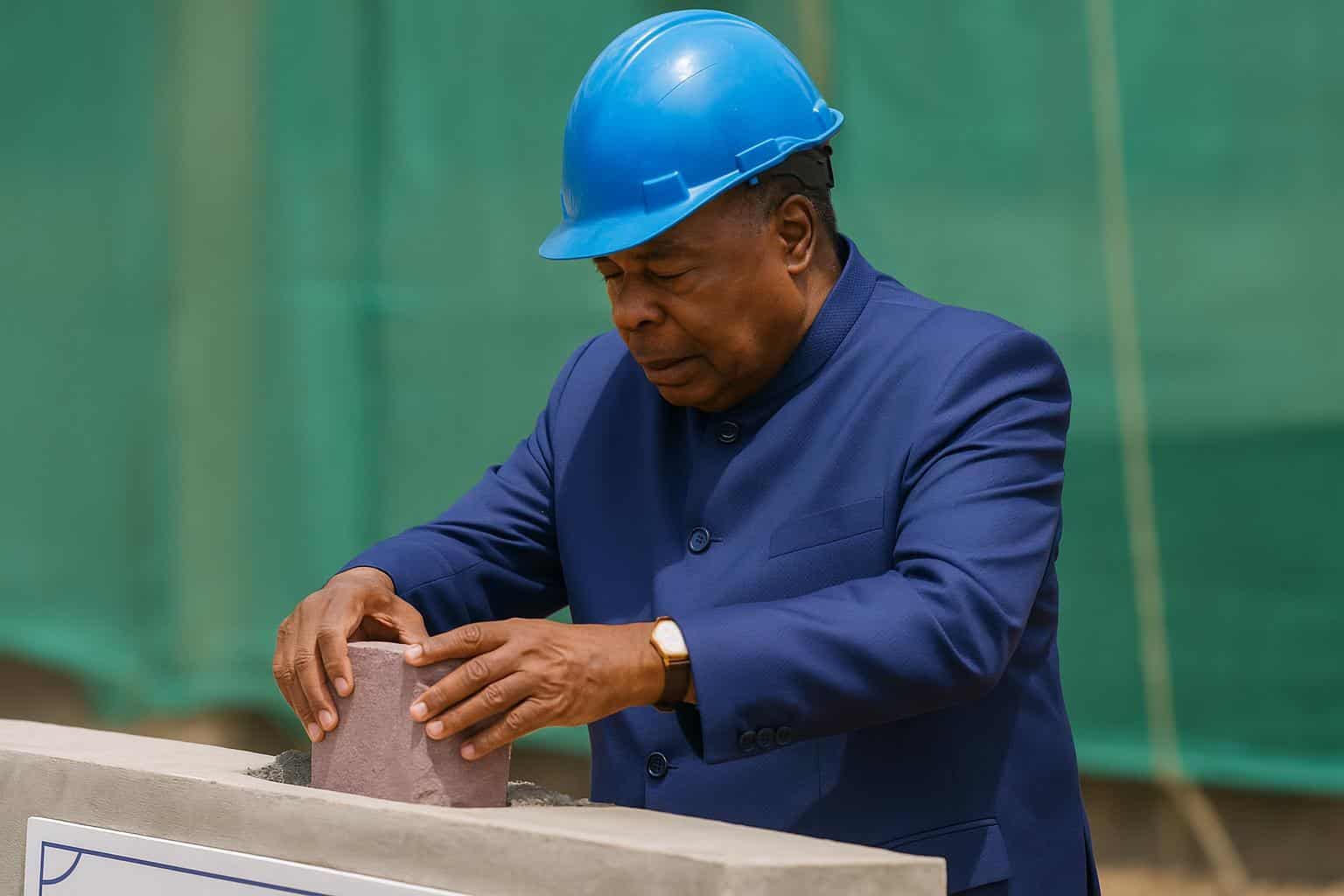
President Denis Sassou Nguesso set shovels moving on 19 December, laying the first stone for the future headquarters of Banque Congolaise de l’Habitat and sending a clear signal that housing finance has become a strategic pillar of Congo’s economic agenda.
Flanked by cabinet members, lawmakers and donor representatives, the head of state framed the project as evidence of confidence in Brazzaville’s financial sector, underscoring his government’s commitment to stable macro fundamentals and domestically anchored capital expenditure despite a challenging global context.
Design and timeline of the seven-storey landmark
The seven-storey glass-and-concrete structure will rise on the bank’s current plot opposite the Directorate-General of Commerce in the city centre, consolidating all administrative and retail operations in one address tailored to modern security, accessibility and environmental efficiency standards.
An unnamed private contractor has been mandated to deliver the building within eighteen to twenty-four months, a timetable designed to minimise service disruption and to align the inauguration with the bank’s fiftieth anniversary planning cycle, according to executives close to the dossier.
Strategy to strengthen housing finance inclusion
BCH director-general Victorien Ndinga described the headquarters as a cornerstone in the institution’s ambition to rank among reference players in affordable-housing funding, stressing that stronger branch networks must be matched by a flagship hub able to host innovative product laboratories.
He pointed to lingering gaps in mortgage penetration and urged staff to view the new premises not as a vanity project but as an operational tool to accelerate on-boarding of low-income households, diaspora savers and small developers historically underserved by traditional commercial banks.
Modernisation agenda and regulatory alignment
Finance minister Christian Yoka, represented by hydrocarbons minister Bruno Jean Richard Itoua, hailed the venture as consistent with the wider modernisation of Congo’s banking ecosystem, which includes gradual digitisation, improved prudential oversight and an emphasis on customer-centric service culture.
Officials argue that bricks-and-mortar investments remain compatible with digital banking because physical visibility reassures savers and allows regulators to enforce stringent anti-money-laundering controls, a prerequisite for closer integration with the Central African Economic and Monetary Community’s payments infrastructure.
Investors’ lens on local value creation
For investors, the construction phase offers a pipeline of subcontracts in civil engineering, electrical works, HVAC, finishing and facility management, potentially supporting dozens of Congolese small and medium enterprises and reinforcing local content throughout the real-estate value chain.
Economic analysts note that capex related to headquarters often stimulate ancillary sectors such as cement, steel and professional services, while signalling to international lenders that management is willing to put equity behind its medium-term growth assumptions.
Urban fabric and real estate dynamics
Urban planners see the project as part of a gradual densification of central Brazzaville, where public and private institutions cluster around key arteries to reduce commuting times and to anchor services in proximity to the future multimodal transport initiatives under consideration.
Architects involved in preliminary studies emphasise that the façade will maximise natural light and incorporate energy-efficient systems, aligning with emerging environmental, social and governance benchmarks increasingly requested by development finance institutions present at the groundbreaking ceremony.
Digital readiness and client convenience
Once operational, the headquarters will centralise retail banking, back-office processing, risk management, treasury and training facilities, allowing BCH to shorten decision loops and to offer one-stop service for mortgages, savings products and small-business loans under one roof.
The board expects the improved workspace to attract qualified young professionals, a critical factor in competing with regional banks and fintechs for talent conversant with Basel standards, cybersecurity and customer-experience design, according to comments shared on the sidelines of the launch.
Funding structure and balance-sheet resilience
Financing details were not disclosed, yet market participants believe the project will be covered by a blend of retained earnings and medium-term credit lines, preserving capital ratios while limiting foreign-exchange exposure amid still-volatile commodity export receipts.
Because the site is already owned by the bank, land acquisition costs are negligible, a configuration that reduces break-even thresholds and could enable the management committee to redirect savings toward branch network refurbishment in secondary cities.
Policy support and development partnerships
Government officials say the headquarters dovetails with national objectives to expand financial inclusion to sixty percent of the adult population over the next few years, an ambition that hinges on both digital outreach and the credibility conferred by well-appointed physical branches.
Development partners attending the ceremony, including multilateral agencies and bilateral funds, reiterated their willingness to accompany the bank through technical assistance on risk scoring, climate-smart housing standards and gender-responsive lending, areas expected to gain prominence once the new building is delivered.
Key milestones and sectoral outlook
Key milestones to monitor in 2024-2025 include completion of the structural frame, installation of core banking IT infrastructure and early testing of integrated customer-relationship platforms, with management vowing to communicate quarterly progress to stakeholders for transparency.
By anchoring its future in the heart of Brazzaville, Banque Congolaise de l’Habitat sends a forward-looking message: housing finance can be both inclusive and profitable, provided institutions align bricks, bytes and prudent governance under a vision fully backed by the state.