
































Digital Company Registration in Congo
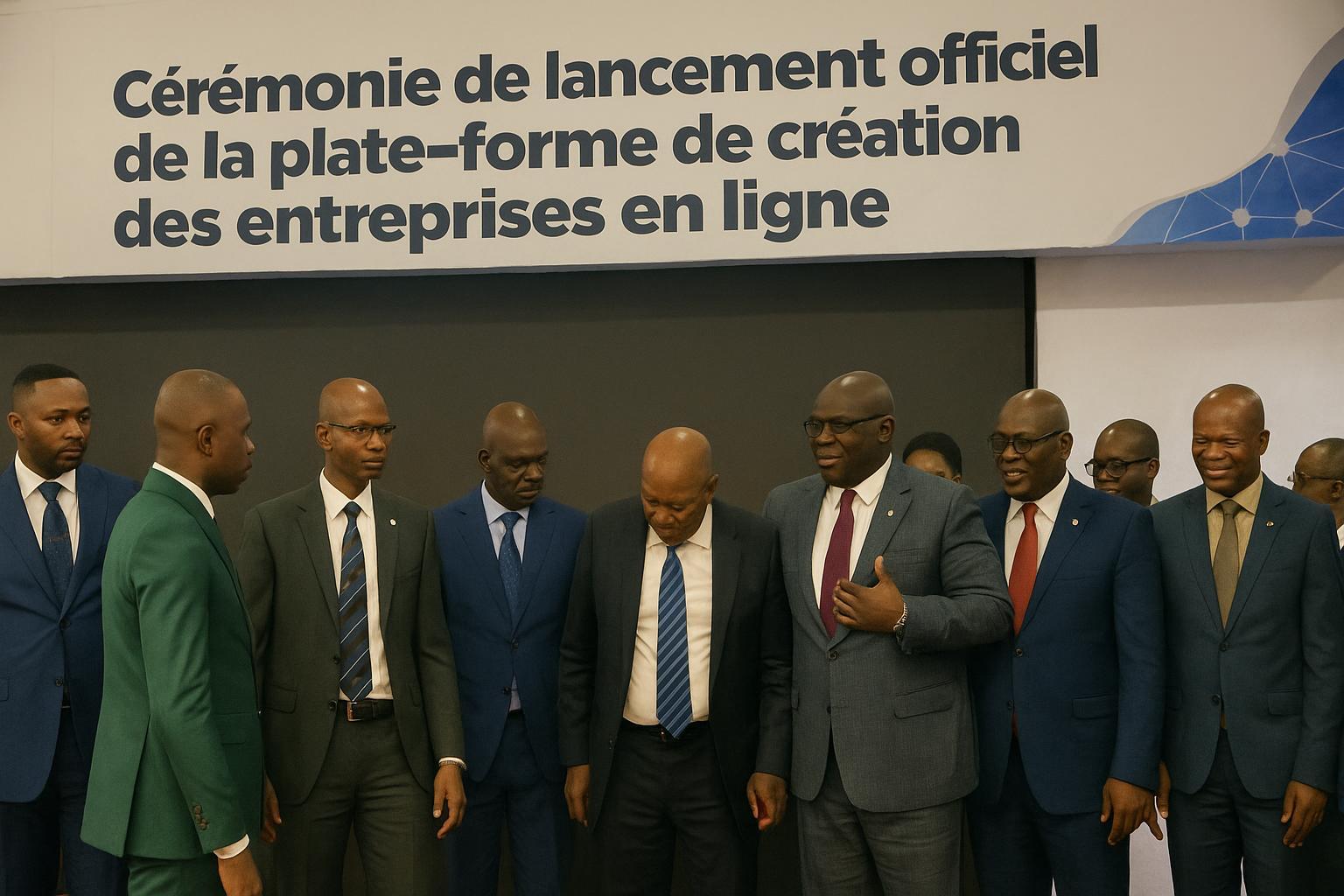
Brazzaville’s government unveiled a fully digital one-stop shop for company registration, managed by the Congolese Agency for Enterprise Creation, ACPCE. More than one hundred entrepreneurs, officials and investors attended the launch at the ministry compound, underscoring the initiative’s high-level backing (RFI, 2023).
Visitors were shown how, from any smartphone or laptop, founders can submit statutes, secure a tax number and obtain the trade registry certificate in under 24 hours. The site is supported by a toll-free 1730 hotline that guides users through each procedural step.
ACPCE director general Emeriand Dieu-Merci Kibangou called the platform a tool for the entire Congolese private sector, including the diaspora. He stressed that location no longer determines access: residents in Pointe-Noire or graduates in Paris can now create a Congolese firm with identical ease.
Lower Thresholds, Higher Ambitions
Regulatory reforms accompany the portal. Equity capital required to incorporate has fallen from 500,000 CFA francs to 25,000, roughly USD 38. Trade minister delegate Inès Nefer Bertille Voumbo Yalo argued that the cut will entice informal traders to formalise and unlock better financing channels.
Time, once another barrier, has also collapsed. What used to involve security clearances and multiple physical queues now happens with a digital signature, an electronic payment and automated interconnection with the tax and social security administrations. For young founders, the difference means days instead of weeks.
Enterprise registrations in Congo-Brazzaville climbed from 1,800 in 2021 to over 5,000 in 2023, according to ACPCE data. Officials expect the online service to accelerate that curve, with a target of 10,000 new entities annually once the diaspora fully engages.
Impact on Doing Business Metrics
Although the World Bank paused its Doing Business publication, investors continue to monitor proxy indicators. Congo previously ranked 180th for starting a business. The new portal shortens procedures from eight to one and cuts official fees by nearly 90 percent, signalling a likely jump in future benchmarks.
A seamless registration process also influences perceptions of political stability and administrative predictability—two determinants highlighted by Moody’s and Fitch when they last assessed Congo’s sovereign outlook. Faster formalisation could therefore translate into a lower risk premium for domestic bond issues.
For multilateral partners such as the African Development Bank, the digital leap supports the country’s public-finance objective of widening the tax base without raising rates. Newly formal SMEs feed accurate turnover data into e-tax platforms, helping the treasury plan expenditure more reliably.
Opportunities for Service Providers
Ancillary markets are emerging around the portal. Legaltech start-ups now offer cloud storage for articles of association, while banks promote instant business bank accounts bundled with ACPCE confirmation codes. Telecom operators see a chance to upsell data packages tailored to founders outside major cities.
Accounting firms expect demand for outsourced bookkeeping to rise as micro-enterprises must submit financial statements to remain in good standing. According to the Pointe-Noire branch of Ordre des Experts-Comptables, monthly retainer quotes for start-ups have already slipped below 50,000 CFA to capture volume.
Diaspora fintechs are positioning to integrate remittance channels directly into the registration interface, allowing relatives abroad to fund statutory capital with a single click. Developers say negotiations are under way with BEAC-licensed providers to ensure compliance with regional anti-money-laundering norms.
Guardrails and Cybersecurity
ACPCE concedes that digitisation raises new risks. Servers are hosted in a hybrid cloud with redundancy in Brazzaville and Paris. The agency states that personal data are encrypted at rest and in transit, and that two-factor authentication will become mandatory for all account holders next quarter.
Legal experts remind founders that the portal does not replace sector-specific licences. A food-processing plant still needs health approvals, and a mining subcontractor must secure permits from the Ministry of Mines. The digital certificate is therefore necessary but not sufficient for full operational readiness.
Some civil-society groups advocate an independent oversight board to audit algorithmic decisions, fearing that opaque code could replicate offline biases. Authorities respond that the system’s workflow mirrors OHADA regulations and that future updates will be published for stakeholder consultation.
Strategic Outlook for Investors
By lowering entry costs, the portal aligns with President Denis Sassou Nguesso’s drive to diversify an oil-dependent economy through entrepreneurship. The next milestone is electronic filing of annual accounts, planned for 2025, which would complete a paperless corporate lifecycle and further de-risk investment.
International partners already see traction: Proparco and the IFC have booked country missions to examine pipeline deals in tech-enabled services. If the momentum holds, Congo-Brazzaville could emerge as a Central African hub where company formation is measured in clicks rather than stamps.
Local universities are adjusting curricula to reflect the shift. Marien Ngouabi University’s business school has introduced a module on online compliance, while private incubators partner with ACPCE to simulate real-time registrations in classroom settings, ensuring graduates hit the ground running.