


















SNPC international scholarships for Congo’s hydrocarbons
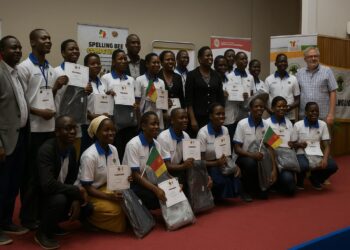
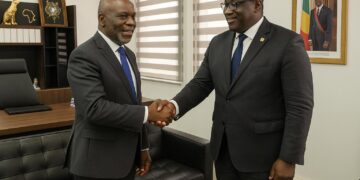
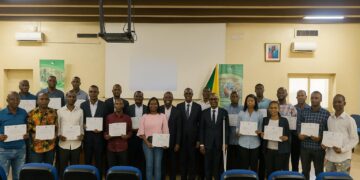
In Brazzaville on January 5, SNPC Director General Maixent Raoul Ominga met four newly selected recipients of the company’s international study scholarships. The initiative is presented as part of a broader effort to strengthen national human resources for Congo-Brazzaville’s hydrocarbons industry (ACI).
According to the same account, the scholarships are designed to support the national policy of skills development by investing early in academic profiles expected to become highly qualified professionals. SNPC frames the program as a structured pipeline to build Congolese expertise aligned with sector needs (ACI).
Four 2025 baccalaureate laureates selected
The new beneficiaries are Géniale Joviale Bokouangou, Ruth-Victoire Bouop-Ngakana, Le Bonheur La Grâce Etou Nko, and Prefis Nixon Louzolo Mikelé. SNPC’s leadership congratulated the students for their academic performance and encouraged them to maintain the standards associated with the award (ACI).
The message conveyed during the meeting linked merit-based selection to a public-interest objective: helping these students evolve into competent cadres who can contribute to the development of the national petroleum sector. The emphasis remained on academic excellence as a strategic asset for the industry (ACI).
Baku studies focused on engineering and oil professions
As presented, the four laureates from the 2025 baccalaureate session will undertake high-level university studies in Baku, the capital of Azerbaijan. Their planned tracks are connected to engineering and oil-related professions within SNPC’s international scholarship program (ACI).
The choice of training routes reflects an orientation toward technical and operational competencies. In SNPC’s narrative, the objective is to match learning pathways with the competencies demanded by the petroleum value chain, supporting both current requirements and future industry evolution (ACI).
Academic discipline and personal commitment highlighted
During exchanges with the students, Maixent Raoul Ominga stressed the importance of academic excellence, discipline, and personal commitment. These were described as decisive values for completing a demanding training path and meeting the expectations associated with the scholarship (ACI).
Discussions also addressed the program’s objectives, university requirements, and the responsibilities that come with this type of support. The framing underscores that the scholarship is not only financial assistance, but also a commitment to performance and accountability throughout the studies (ACI).
A program aligned with national skills development policy
ACI reports that the program is implemented in support of the national policy for developing competencies. SNPC states that the aim is to build durable Congolese expertise, calibrated to the industry’s present and future needs, and anchored in recognized academic performance.
Priority is given to pupils with remarkable academic results and strong scientific potential. This selection approach positions the scholarships as a targeted human-capital instrument, seeking to identify promising profiles early and provide them with training environments specialized in hydrocarbons-related fields (ACI).
Continuity with the first cohort in Azerbaijan and Algeria
The four new recipients are reported to receive the same advantages as the first cohort, described as around twenty students placed since September 2025 in specialized higher-education institutions in Azerbaijan and Algeria. This continuity suggests a program structured in successive intakes (ACI).
The benefits cited include coverage of training and living costs, alongside academic support. By pairing financial coverage with follow-up, SNPC presents the scholarships as a comprehensive package intended to maximize student success and, over time, reinforce the national talent base (ACI).
What investors and decision-makers may take from the initiative
For public decision-makers and market participants, the announcement signals an emphasis on workforce readiness in a strategic sector. In institutional terms, the scholarship program illustrates how corporate instruments can accompany public objectives, especially in technically demanding industries such as hydrocarbons (ACI).
For families and the diaspora, the initiative highlights an avenue for internationally oriented training linked to national development priorities. For the students themselves, the stated expectations remain clear: sustain performance, respect academic standards, and prepare for professional responsibility (ACI).