




























A royal-backed model rooted in Fez
In Fez, a training centre dedicated to artisanal trades has spent more than 15 years supporting the socio-professional integration of young people living in precarious conditions. Visitors to the site on December 24 heard how the initiative links employability to the preservation of Morocco’s national heritage (ACI).
Governance and public partnership
Created at the initiative of King Mohammed VI, the centre is managed by an association working with the state. Its operational framework is anchored in a tripartite agreement involving several ministries, reflecting a public-policy approach to skills development and cultural valorisation (ACI).
The centre’s stated mandate is to qualify young people for wage employment or for self-employment. In practice, this positions vocational training as both a labour-market instrument and a tool of soft cultural resilience, by sustaining know-how typically concentrated in historic medina ecosystems (ACI).
Free access targeting early school leavers
Training is fully free of charge. The centre primarily targets young people who left school as early as primary level, yet it remains open to varied profiles, including higher-education graduates who arrive with a professional project and seek a practical pathway into the crafts economy (ACI).
This admissions stance broadens the centre’s potential impact. It treats artisanal training not only as a safety net for vulnerable youth, but also as a re-skilling option for project holders who want to transform credentials into marketable, workshop-based competencies (ACI).
Apprenticeship: 80% practice, 20% theory
According to director Ahmed Aboujaafar, the centre’s pedagogy is structured around apprenticeship, with 80% practice and 20% theory. Courses are delivered by professional artisans, notably from the medinas, who transmit skills inside dedicated, equipped workshops provided by the centre (ACI).
This choice of instructors matters for investors and policy observers: it channels tacit knowledge into formalised training, while keeping production techniques anchored in real-world craftsmanship. The emphasis on workshop time also signals a competence-based logic aligned with employability outcomes (ACI).
25 crafts, including trades at risk of disappearing
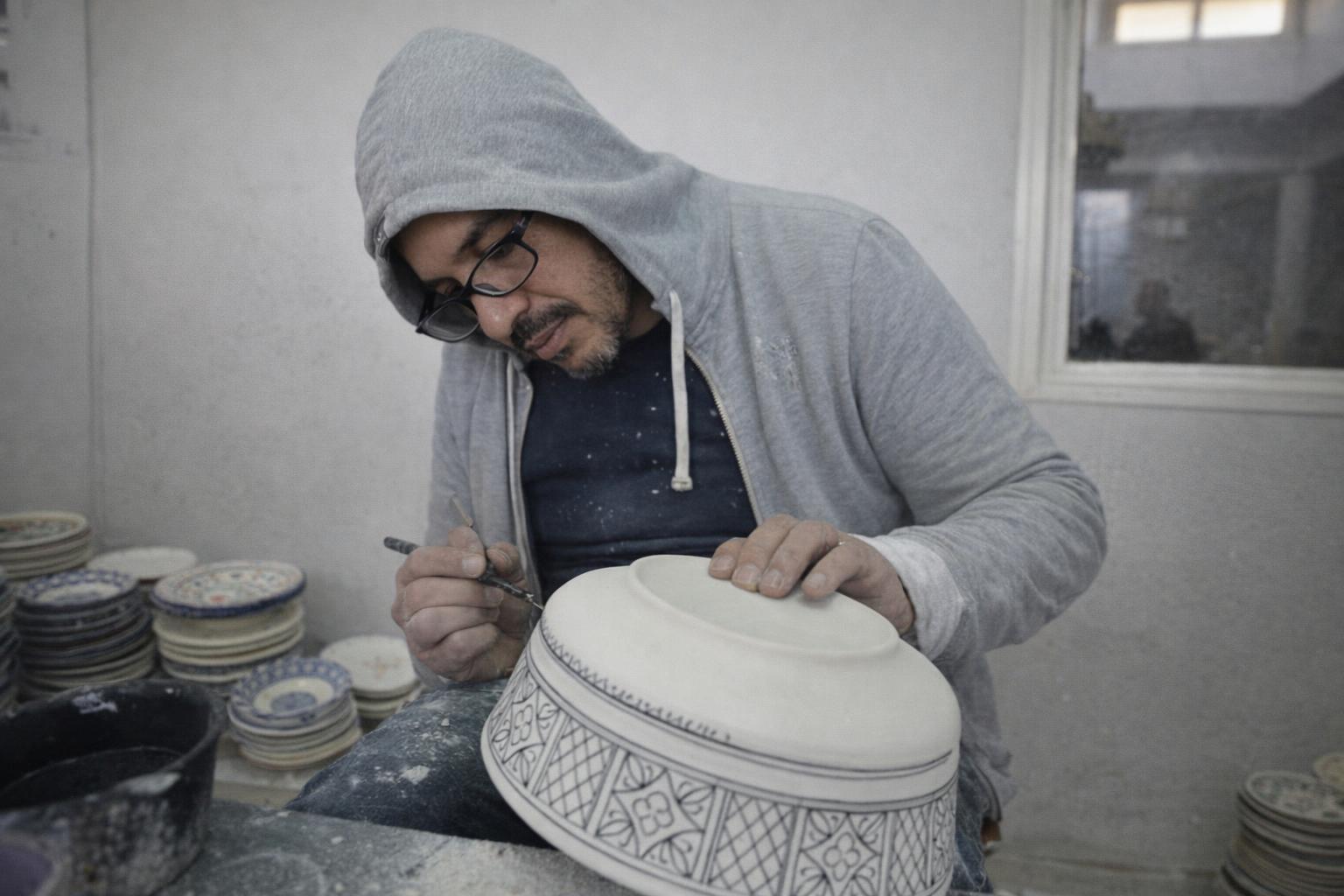
Each year, the centre trains about 600 to 650 apprentices across 25 artisanal trades, several described as threatened with disappearance. The portfolio includes traditional weaving, carpet making, jewellery in traditional and modern styles, sewing and embroidery, and tapestry work (ACI).
Training also covers sculpted plasterwork, pottery, artistic ironwork, and metalworking, including dinanderie and copper work. Woodturning, bookbinding, and traditional horse saddlery are also part of the catalogue, illustrating a deliberate effort to keep complex craft chains alive (ACI).
Diplomas recognised by the state and a reported 80% insertion
Programmes run for one to two years depending on the complexity of the trade. Graduates receive a diploma recognised by the state. The centre also operates a follow-up mechanism to assess professional outcomes, and its managers estimate an insertion rate close to 80% (ACI).
The combination of certification and monitoring is presented as a credibility lever. By pairing a state-recognised credential with tracking, the centre frames artisanal training as a measurable investment in human capital, rather than an informal pathway with uncertain returns (ACI).
Employment support and microcredit linkages
Beyond training, the centre hosts a unit dedicated to employment support and business creation. This is done in partnership with specialised structures and with microcredit organisations, intended to assist young people who want to launch their own activity after graduation (ACI).
For decision-makers, this ecosystem approach is notable: it treats workshop skills as necessary but insufficient, and seeks to bridge the gap between learning and income generation. Access to microcredit is presented as a practical lever for equipment, materials, and initial working capital (ACI).
African cooperation: a quota for continental trainees
The centre is also described as open to African cooperation. Under the terms of its agreement with the state, it reserves at least 5% of its places for young people from other African countries, giving the initiative a modest but explicit regional dimension (ACI).
This component positions vocational training as a platform for exchange. While the article does not specify partner countries or selection modalities, the quota signals an intent to connect Morocco’s artisanal expertise with broader African skills mobility and cultural linkages (ACI).
A national ripple effect across Morocco
The experience in Fez is presented as pioneering in Morocco and has reportedly inspired the creation of similar centres in Salé and Marrakech. The replication suggests an emerging national dynamic that uses artisan training as both an employment policy tool and a heritage-preservation strategy (ACI).
For stakeholders tracking Morocco’s productive sectors, the Fez model illustrates how cultural industries can be structured through public partnership, certified pathways, and practical pedagogy. Its reported scale, governance format, and replication provide a reference point for skills policy design (ACI).