































Global Push for Sustained AIDS Financing
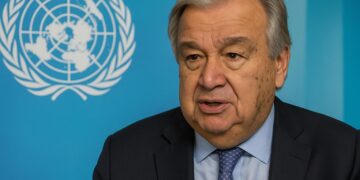
Speaking from New York for World AIDS Day 2025, UN chief António Guterres urged governments and partners to raise the pace and the volume of HIV financing, stressing that prevention budgets have flattened just as needs rise. He labelled steady cash flow the single most decisive factor in protecting hard-won gains.
Guterres cited UNAIDS estimates that an additional 2.2 billion USD annually would allow full coverage of proven prevention tools, from pre-exposure prophylaxis to community outreach. Without that lift, service gaps could grow, especially in regions where donor support is tapering in tandem with mounting macro-fiscal pressures.
The Secretary-General reminded stakeholders that every dollar spent on prevention saves multiple dollars in treatment and productivity losses over time, a ratio documented by the World Bank and echoed by the Global Fund. He framed prevention spending as a development investment rather than a cost centre, aligning it with the broader 2030 Sustainable Development Goals.
Progress Since 2010 Offers a Roadmap
Global new infections have fallen by roughly 38 percent since 2010, while AIDS-related deaths have dropped by more than half, according to the 2024 UNAIDS epidemiological update. Expanded antiretroviral therapy, now reaching nearly 30 million people, underpins those results.
Guterres noted that viral suppression rates climb sharply when treatment is started early and maintained, underscoring the value of predictable commodity pipelines. The cost of a first-line regimen has fallen below 60 USD per patient-year, demonstrating how scale and competition can bend the price curve.
Yet 630 000 lives were still lost to AIDS in 2023 and close to 40 million people continue living with the virus. Experts at the London School of Hygiene point out that the final mile is always the toughest, often requiring tailored, community-led approaches that are harder to finance through traditional vertical programmes.
Human Rights at the Center of Health Policy
The UN message gave equal weight to legal and social barriers, warning that criminalisation, stigma and gender-based violence deter people from seeking prevention and treatment. Guterres argued that rights-based reforms can be as pivotal as laboratory breakthroughs in ending the epidemic.
He called on states to decriminalise key populations, protect patient confidentiality and integrate HIV services into universal health coverage packages. Analysts at Human Rights Watch agree that dismantling discrimination increases health service uptake, thereby boosting the efficiency of every donor or taxpayer franc invested.
Several countries have piloted integrated service models where HIV testing, reproductive health and tuberculosis screening are offered in one visit. Early evidence from Botswana and Thailand suggests such convergence raises retention rates and lowers marginal costs, making a fiscal case for reforms grounded in rights.
Strategic Relevance for Congo-Brazzaville and CEMAC
Central Africa accounts for a modest fraction of global HIV prevalence yet faces structural financing challenges. In Congo-Brazzaville, recent IMF Article IV consultations emphasised the need to shield core social spending as the country consolidates its debt position and diversifies away from hydrocarbons.
National prevalence sits near 3.2 percent, below the sub-Saharan average, but urban hot spots sustain transmission. The Ministry of Health’s 2024–2028 strategic plan earmarks 22 percent of its HIV budget for prevention, signalling alignment with the UN call. Maintaining that share will demand resource mobilisation beyond traditional aid.
Public-private cooperation is gaining traction. The Pointe-Noire Special Economic Zone now requires tenant firms to offer on-site voluntary testing and linkage to care, an approach endorsed by the Congolese Business Federation. Such initiatives illustrate how economic development zones can double as platforms for inclusive health coverage.
Opportunities for Public-Private Partnerships
Investors focused on ESG metrics increasingly view health outcomes as material to country risk and labour productivity. Debt-for-health swaps, modelled on recent tropical-forest debt conversions, are being explored by several CEMAC states as a mechanism to channel savings into HIV services.
Fin-tech solutions are also emerging. A Congolese start-up backed by the African Development Bank is piloting mobile wallets that reimburse transport costs for clinic visits, reducing a documented barrier to continuity of care. If scaled, such tools could complement existing Global Fund disbursements while creating local tech jobs.
Guterres closed his address by underlining that collective capacity, from multilateral lenders to grassroots innovators, is sufficient to end AIDS as a public health threat by 2030. What remains, he said, is the political will to align capital flows, legal reforms and corporate engagement behind that clear, measurable objective.