

























Fresh Capital for Brazzaville Urban Farmers
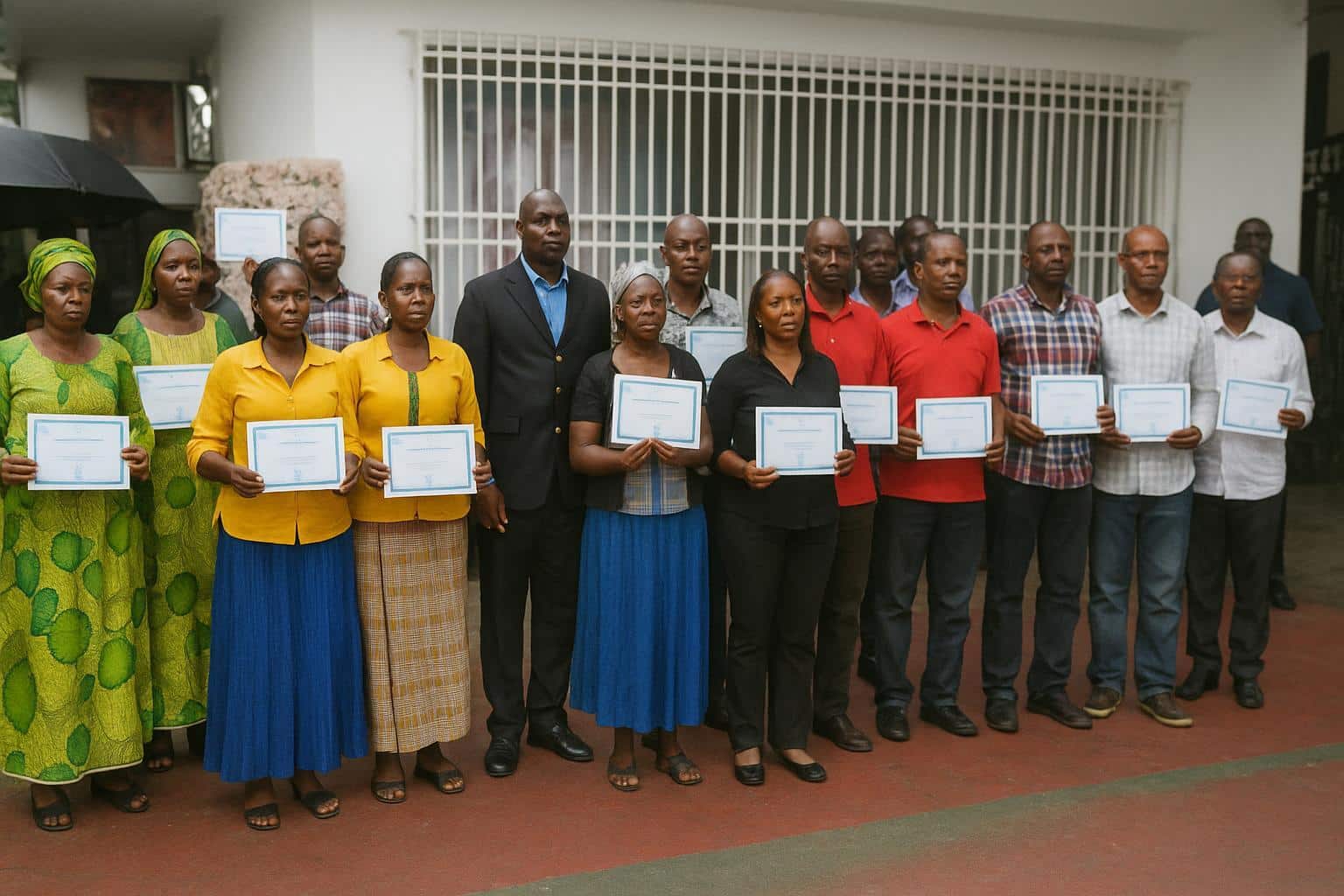
Brazzaville’s skyline echoed with optimism on 9 December as Aser Sidney N’se, president of La Congolaise Agricole, handed thirty cheques worth between CFA 100,000 and CFA 1.5 million to urban farmers, marking a fresh injection of working capital into a sector hungry for liquidity.
The transaction, executed in a modest ceremony but amplified across farming networks, launches the cooperative’s 2025-2026 agricultural roadshow designed to formalise support for market gardeners, fish farmers and livestock breeders operating in and around the Congolese capital.
Cheques Anchor a Results-Driven Support Model
Mr N’se insisted that the new envelopes “must differ from previous schemes,” noting that earlier grants often fizzled for want of monitoring. His team, he said, would track utilisation and link disbursements to clear production and commercial milestones agreed with each beneficiary.
The amounts are modest by commercial-bank standards yet significant for smallholders who often self-finance inputs at interest rates topping 25 percent. A single CFA 1.5 million ticket, roughly 2,400 dollars, can cover improved seed, fingerlings, feedstock and basic irrigation for a one-hectare plot.
CCD Partnership Aims to Unlock Blended Finance
Central to scalability is a partnership under negotiation with the Caisse pour le Commerce et le Développement, better known as CCD. The development lender could co-finance subsequent tranches, leveraging concessional lines and risk-sharing instruments to multiply the cooperative’s capital severalfold.
Analysts view the CCD link as pivotal because many micro-projects stall at the second season, precisely when replacement of inputs meets tight working-capital cycles. Blended finance could smooth that valley of death and standardise agricultural credit scoring for small operators.
Aligning with Investment Charter and AfCFTA Horizon
Financing arrives at an opportune moment. Food inflation in Brazzaville hovered near 7 percent this year, and the government’s import bill for staples remains above 450 million dollars. Policy planners routinely cite urban agriculture as a quick-win lever to lift supply and cut import dependence.
La Congolaise Agricole is itself a product of fiscal incentives embedded in the 2021 Investment Charter, which offers tax holidays and accelerated depreciation for agri-food ventures. By channelling private funds rather than relying solely on public subsidies, the cooperative aligns neatly with that policy shift.
The theme chosen for the roadshow—“Training, Structuring and Supporting Ambassadors of the Land to Compete under AfCFTA’s Twilight”—hints at a broader agenda: readying Congolese producers for tariff-free continental trade. Certification, traceability and consistent quality will be essential tickets to that dance.
Producers’ Voices Reveal Ground-Level Impact
Beneficiary voices underscore the stakes. “I started but almost collapsed; without help you are stuck,” admitted agro-pastoralist Tsabelle Kibozi, who plans to reboot her fishponds and small cattle unit with the cheque. Similar stories echo across Makélékélé, Talangaï and Poto-Poto districts.
Tech-Enabled Monitoring and Inclusive Finance
For women entrepreneurs, access to flexible cash can be game-changing. National data show women represent nearly 60 percent of the informal food economy yet capture less than 10 percent of formal agricultural credit. The cooperative hopes its revolving model will narrow that gender gap.
Within the cooperative, monitoring hinges on a WhatsApp-based dashboard where farmers upload weekly photos of plots, pond water tests and livestock weight tables. Extension officers validate entries during field visits, feeding a geocoded map that could later interface with insurers or carbon-credit registries.
Infrastructure Gaps Remain a Strategic Priority
Economists caution, however, that grants alone cannot secure food self-reliance. Investments in cold storage, rural roads and local feed mills remain critical complements. The Ministry of Agriculture’s 2024-2028 plan earmarks 180 billion CFA for such enablers, signalling public-private convergence.
Roadmap to National Roll-Out
Aser Sidney N’se framed persistence as the decisive variable. “The path has never been easy, but your faith brought us here,” he told recipients, urging them to treat the cheques as catalytic rather than consumptive money. Performance reviews are scheduled every quarter through 2026.
The Brazzaville pilot will inform roll-outs in Pointe-Noire, Ouesso and Dolisie, where climatic conditions diverge sharply. Agronomists anticipate learning curves in pest management and feed formulation, lessons that could refine the grant algorithm before national-scale deployment.
Banking Sector Signals Growing Appetite
Regional bankers are watching. A senior credit officer at BGFI Bank Congo confirms exploratory talks on a guarantee window dedicated to agricultural SMEs. “Once we see two harvest cycles with proper records, we can open term loans at single-digit rates,” the officer explained.
That prospect fits into the central bank’s drive to deepen local-currency lending and curb dollarisation. By anchoring credit in francs CFA, policy makers hope to stabilise rural cash flows and insulate farmers from external shocks, including fertiliser price swings and freight disruptions.
Why the Initiative Matters for Congo’s Export Ambition
As continental free-trade deadlines loom, initiatives like La Congolaise Agricole’s cheque drive embody a pragmatic pathway: modest sums, strict follow-up and blended finance. If execution matches design, Brazzaville’s farmers could become competitive nodes in the Congo’s longer-term ambition to export more than crude.