



















• About us
  • Advertising
  • Careers
  • Contact
Congo-Brazzaville
Thursday, January 15, 2026
No Result
View All Result
CONTRIBUTE
Congo Investor
  • Home
  • World

    Italy’s €236m Health Deal Upgrades Congo Hospitals

    Congo–China Paintings Reveal a New Soft-Power Push

    Morocco’s AFCON 2025 earns FIFA praise in Rabat

    Inside Morocco’s Royal Craft School in Fez

  • Politics

    3,719 Congo Passports Ready—Yet Still Unclaimed

    Mindouli Tension Sparks Flight on Congo Key Highway

    UN Agencies Back CNTR to Boost Congo Transparency

    Congo’s 2021-2026 Plan Explained on TV: Key Takeaways

  • Companies

    Congo Fintech Boost: Bantulab’s €1m Incubator

    UBA POS at Étoile de Brazza: a new cashless boost

    SNPC Sends Elite Students to Oil School in Baku

    Brazzaville Christmas Market Hits 17m CFA

  • Tech

    Congo’s AI Rules Push: What Investors Should Watch

    Congo Unveils One-Stop Digital Start-Up Portal

    Super-App GoChap Debuts in Brazzaville Market

    Congo’s Innovators Stalled by Costly Patent Fees

  • Markets

    Congo Butane Gas Prices: Authorities Step In

    Brazzaville to Host Major Francophone Business Forum

    Congo crude prices: why Q4 2025 stayed competitive

    Congo, DR Congo Unite to Digitise Insurance

  • Climate

    Congo’s Bacassi Project: Carbon, Farms, Jobs

    Congo Climate Negotiators: Skills That Pay Off

    Congo Climbs to PAFCA Co-Chair, Investors Watch

    Safoutier Leads Congo Plant Fair, Green Market Buzz

  • Society & Arts

    Lamuka’s Rise: Women with Disabilities Lead Change

    Why Mike Tyson’s Kinshasa Pilgrimage Resonates

    VOQUART Ignites Brazzaville’s Peripheral Revival

    Brazzaville’s Taxi Bomoyi: Drivers Taking on Diabetes

  • Work & Careers

    SNPC Scholarships: 4 Top Graduates Head Abroad

    Brazzaville Climate Bootcamp Sparks Green Careers

    Brazzaville’s PSIPJ: 45,000 Youth Target by 2026

    Detail Management: Congo’s New Guide for Leaders

  • Home
  • World

    Italy’s €236m Health Deal Upgrades Congo Hospitals

    Congo–China Paintings Reveal a New Soft-Power Push

    Morocco’s AFCON 2025 earns FIFA praise in Rabat

    Inside Morocco’s Royal Craft School in Fez

  • Politics

    3,719 Congo Passports Ready—Yet Still Unclaimed

    Mindouli Tension Sparks Flight on Congo Key Highway

    UN Agencies Back CNTR to Boost Congo Transparency

    Congo’s 2021-2026 Plan Explained on TV: Key Takeaways

  • Companies

    Congo Fintech Boost: Bantulab’s €1m Incubator

    UBA POS at Étoile de Brazza: a new cashless boost

    SNPC Sends Elite Students to Oil School in Baku

    Brazzaville Christmas Market Hits 17m CFA

  • Tech

    Congo’s AI Rules Push: What Investors Should Watch

    Congo Unveils One-Stop Digital Start-Up Portal

    Super-App GoChap Debuts in Brazzaville Market

    Congo’s Innovators Stalled by Costly Patent Fees

  • Markets

    Congo Butane Gas Prices: Authorities Step In

    Brazzaville to Host Major Francophone Business Forum

    Congo crude prices: why Q4 2025 stayed competitive

    Congo, DR Congo Unite to Digitise Insurance

  • Climate

    Congo’s Bacassi Project: Carbon, Farms, Jobs

    Congo Climate Negotiators: Skills That Pay Off

    Congo Climbs to PAFCA Co-Chair, Investors Watch

    Safoutier Leads Congo Plant Fair, Green Market Buzz

  • Society & Arts

    Lamuka’s Rise: Women with Disabilities Lead Change

    Why Mike Tyson’s Kinshasa Pilgrimage Resonates

    VOQUART Ignites Brazzaville’s Peripheral Revival

    Brazzaville’s Taxi Bomoyi: Drivers Taking on Diabetes

  • Work & Careers

    SNPC Scholarships: 4 Top Graduates Head Abroad

    Brazzaville Climate Bootcamp Sparks Green Careers

    Brazzaville’s PSIPJ: 45,000 Youth Target by 2026

    Detail Management: Congo’s New Guide for Leaders

No Result
View All Result
Congo Investor
No Result
View All Result
Home Politics

Brazzaville’s Prescription: Funds, Climate, Clinics

by Michael Mwamba
July 19, 2025
in Politics
Reading Time: 3 mins read

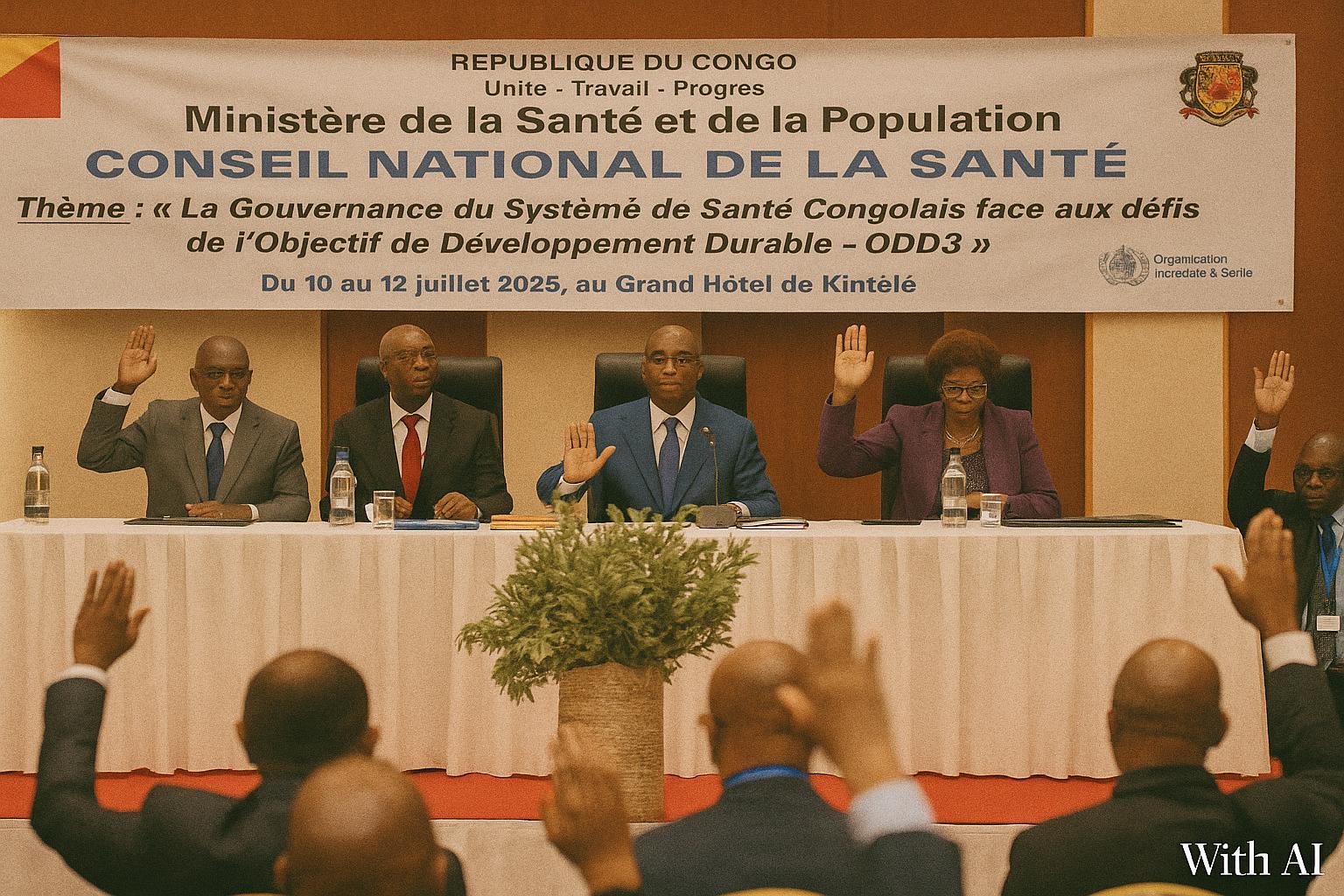
National Consensus Emerges in Brazzaville

When the Congolese National Health Council adjourned its second session on 18 July, delegates left the marble halls of Brazzaville’s ministry complex with a rare sense of unanimity. Experts, parliamentarians and development partners endorsed a package of recommendations designed to fortify a health system still recovering from the fiscal aftershocks of the pandemic and the structural legacies of a decade-long oil downturn. Although the Council is not a legislative body, its communiqués traditionally prefigure cabinet decisions; accordingly, observers in the diplomatic community read the July resolutions as a policy lodestar for the administration of President Denis Sassou Nguesso.

Financing Reform Anchored in Domestic Resources

At the heart of the roadmap lies the question of money—specifically, how to raise it at home rather than rely exclusively on concessional credit. The Council urged the treasury to raise the health budget from its current level of roughly 4.3 percent of GDP toward the 6 percent regional benchmark recommended by the African Union (AU, 2023). Officials close to the file suggest that incremental earmarking of VAT proceeds, coupled with a reallocation of hydrocarbon royalties, is under active study. The World Bank’s most recent Public Expenditure Review argued that each percentage point shift toward primary care could reduce out-of-pocket payments by eight percent (World Bank, 2024), a statistic now circulating in ministerial briefing notes.

Infrastructure and District Revitalisation

Beyond fiscal architecture, the Council’s deliberations placed renewed emphasis on bricks and mortar. A diagnostic led by the National School of Public Health found that nearly forty percent of rural dispensaries lack reliable electricity, hampering vaccine cold chains. The new agenda therefore prioritises solar micro-grids and modular clinics in the Sangha and Likouala departments, echoing recommendations by the International Renewable Energy Agency (IRENA, 2022). Complementing these investments, the Council endorsed a policy of ‘district revitalisation’, reviving a model that once allowed peripheral centres to manage their own revolving drug funds with minimal red tape. According to former health minister Georges Moyen, interviewed for this piece, “empowering districts is fiscally prudent because it decentralises accountability without diluting national oversight.”

Climate Resilience Becomes a Health Metric

Perhaps the most forward-looking element of the communiqué is its explicit linkage between climate volatility and epidemiological risk. Congo-Brazzaville’s equatorial latitude renders it vulnerable to vector-borne diseases that thrive in warmer, wetter conditions; malaria transmission length now averages ten months in some forest districts compared with eight a decade ago (WHO, 2023). The Council therefore advises embedding climate indicators into routine surveillance, a move aligned with the African Centres for Disease Control climate-health framework adopted in Addis Ababa this year. Diplomats from coastal states welcomed the development, noting that regional disease spill-overs ignore borders even when politics does not.

Private Sector Synergies and Community Engagement

While public finance dominated headlines, quieter wording on public-private cooperation may prove equally transformative. The Council invited the Ministry of Health to negotiate service-level agreements with accredited private clinics, allowing them to claim reimbursements for basic procedures under the nascent Universal Health Insurance Fund. Similar schemes in Côte d’Ivoire lifted institutional delivery rates by twelve percent in two years (UNICEF, 2022), figures that Congolese planners hope to replicate. Community groups are also slated for a larger role. Civil-society physician Dr Solange Mampouya commented that “partnership without grassroots engagement is diplomacy without dialogue,” capturing the Council’s intent to formalise village-level health committees.

Regulatory Modernisation and Administrative Timelines

To underpin these policy pivots, delegates approved draft amendments to Decree 84-290, the legal instrument that established the Council four decades ago. The revised text, now en route to the Council of Ministers, clarifies reporting lines between the Secretariat-General for Health and provincial directorates, while introducing performance audits aligned with Sustainable Development Goal 3. Sources within the Prime Minister’s office anticipate promulgation before the end of the fiscal year, a timeline regarded as ambitious yet feasible given the President’s public endorsement during his May Day address.

Strategic Implications for International Partners

For bilateral donors and multilateral lenders, the July communiqué offers a calibrated signal of reform momentum without disclosing every budgetary line item. The African Development Bank is preparing a 60-million-dollar sector budget support tranche contingent on the very indicators the Council has now validated (AfDB, 2024). European envoys interviewed in Brazzaville emphasised that predictable domestic financing unlocks concessional co-financing, effectively leveraging the Republic’s hydrocarbon revenue for social investment. In private conversation, one senior diplomat called the Council’s resolutions “a prudent hedge against both epidemiological and political risk.”

Prospects for Implementation and Regional Leadership

Minister of Health and Population Jean-Rosaire Ibara closed the session with a call for vigilance and courage, urging stakeholders to convert rhetoric into results. His language echoed the broader posture of the administration, which increasingly presents health security as a pillar of national sovereignty. Success, however, will hinge on administrative bandwidth and the delicate choreography between central and provincial actors. Should the reforms materialise, Congo-Brazzaville could position itself as a regional exemplar of post-pandemic recovery, illustrating that fiscal prudence and social ambition are not mutually exclusive. In a sub-region where policy continuity is often fragile, the July roadmap represents an instructive counter-narrative—and perhaps a diplomatic asset in its own right.

Previous Post

Congolese Power Push: PASEL Lights the Grid

Next Post

Petro Patronage Fuels Congo’s Campus Ambitions

Related Posts

3,719 Congo Passports Ready—Yet Still Unclaimed

by Michael Mwamba
January 15, 2026

Congo passports: an administrative paradox Access to a passport remains a major issue for many Congolese citizens, yet official figures...

Mindouli Tension Sparks Flight on Congo Key Highway

by Michael Mwamba
January 13, 2026

Pool department: gunfire near Mandou bus station An armed confrontation on Sunday, 11 January 2026, near the Mandou bus station...

UN Agencies Back CNTR to Boost Congo Transparency

by Michael Mwamba
January 13, 2026

UN–CNTR Talks Signal Governance Momentum UN agencies operating in the Republic of the Congo have reaffirmed their commitment to support...

Congo’s 2021-2026 Plan Explained on TV: Key Takeaways

by Michael Mwamba
January 12, 2026

Brazzaville TV series puts the five-year plan in focus Brazzaville hosted a politically significant public discussion on 8 January, as...

Congo 2026: MCDDI urges Sassou N’Guesso to run

by Michael Mwamba
January 12, 2026

Brazzaville signal ahead of the March 2026 vote In Brazzaville, the Congolese Movement for Democracy and Integral Development (MCDDI) has...

DGSP’s ‘Zero Kuluna’ Reaches Oyo: 4 Arrests

by Michael Mwamba
January 10, 2026

DGSP deployment to Oyo under ‘Zero Kuluna’ Elements of the General Directorate of Presidential Security (DGSP) officially set foot in...

Load More
Next Post

Petro Patronage Fuels Congo’s Campus Ambitions

Popular News

  • 3,719 Congo Passports Ready—Yet Still Unclaimed

    0 shares
    Share 0 Tweet 0
  • Congo Butane Gas Prices: Authorities Step In

    0 shares
    Share 0 Tweet 0
  • Congo Fintech Boost: Bantulab’s €1m Incubator

    0 shares
    Share 0 Tweet 0
  • Mindouli Tension Sparks Flight on Congo Key Highway

    0 shares
    Share 0 Tweet 0
  • Congo’s AI Rules Push: What Investors Should Watch

    0 shares
    Share 0 Tweet 0

Your trusted platform for economic and financial reporting, covering markets, energy, and industrial developments shaping Congo-Brazzaville’s future.

Sections
  • Home
  • World
  • Politics
  • Companies
  • Tech
  • Markets
  • Climate
  • Society & Arts
  • Work & Careers
  • Home
  • World
  • Politics
  • Companies
  • Tech
  • Markets
  • Climate
  • Society & Arts
  • Work & Careers
Legal & Policies
  • Cookie Policy
  • Corrections Policy
  • Fact-Checking Policy
  • Privacy Policy
  • Republishing Policy
  • Slavery and Human Trafficking Statement
  • Terms and Conditions
  • Cookie Policy
  • Corrections Policy
  • Fact-Checking Policy
  • Privacy Policy
  • Republishing Policy
  • Slavery and Human Trafficking Statement
  • Terms and Conditions
Services
  • About us
  • Advertising
  • Careers
  • Contact
  • Join Our Network of Contributors
  • About us
  • Advertising
  • Careers
  • Contact
  • Join Our Network of Contributors

2025 CongoInvestor – All Rights Reserved.

No Result
View All Result
  • Home
  • World
  • Politics
  • Companies
  • Tech
  • Markets
  • Climate
  • Society & Arts
  • Work & Careers

© 2025 Congo Investor - All Rights Reseved.