



















Strategic value of the southern power corridor
Central government has quietly accelerated the overhaul of the 510-kilometre Pointe-Noire-Brazzaville line, a spine that already carries around 70 percent of the electricity consumed in the south-western corridor, officials at the Ministry of Energy confirmed during Minister Emile Ouosso’s recent field mission (Les Dépêches de Brazzaville).
With hydrocarbons revenues still anchoring fiscal space, policymakers view grid reliability as the fastest lever for diversifying growth toward logistics, agro-industry and emerging tech services that cluster along National Route 1, analysts at the African Development Bank explained in their 2023 Congo country diagnostic (AfDB).
Loudima node: civil works completed
At Loudima, Italian major Eni is reinforcing two 225/400-kV transformers, adding shunt reactors and modern protection relays. Civil works, including fourteen concrete gantries, are finished, site supervisor Aurélien Moukoumi told reporters, noting that mechanical erection will start once high-voltage compensators land from Padua next quarter.
The ministry insists deadlines remain aligned with the February-March 2026 window written into the turnkey contract, which carries penalties of 0.1 percent of contract value per late day, according to a person familiar with the documents who requested anonymity because discussions are ongoing.
Dolisie HT-MT hub extends regional reach
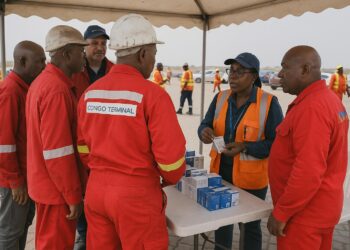
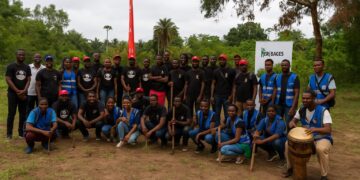
Earlier, the delegation walked the red-soil perimeter of the new 110/30-kV Dolisie substation, where Chinese-manufactured breakers and isolators are neatly stored under tarpaulins. Project engineer Joseph Balé Nguenfiri said concrete plinths are curing and that stringing toward Mossendjo should commence before the heavy rains.
State utility Énergie Électrique du Congo, headed by Jean Bruno Danga Adou, expects the Niari hub to cut voltage dips that now average 12 percent during evening peaks, a level above Economic Community of Central African States guidelines, and to free capacity for future industrial off-takers.
Financing roadmap and contractual safeguards
Financing combines a sovereign tranche under the 2021-2025 Public Investment Program and a concessional line from the Export-Import Bank of China, totalling about 145 million dollars, officials confirmed. Eni contributes in-kind through equipment and training valued at roughly 12 million dollars under its production-sharing commitments.
Technical upgrade from 225 kV to 400 kV
Most of the current conductors date back to 1982 and operate at 225 kV. Upgrading to 400 kV doubles thermal capacity, reduces technical losses by an estimated three percentage points and strengthens Congo’s negotiating position for eventual interconnection with the CAPP regional market, engineers argue.
Managing outages and public expectations
Ouosso’s message to households was candid: crews cannot splice live lines. Planned outages will therefore persist, mainly on weekends, and advance notices will circulate through radio and SMS channels. Customer satisfaction metrics will be tracked weekly, a practice borrowed from Ghana’s Energy Commission benchmarks.
Economic multiplier for local industries
Business leaders in Dolisie stress that reliable power is essential for sawmills processing okoumé timber and for the cassava starch plant slated for 2025. The Chamber of Commerce estimates these investments could lift provincial GDP by 1.8 percent once grid stress eases.
Local content and skills transfer
Under the revised Hydrocarbons Code, operators benefiting from cost-oil offsets must deliver capacity-building. Eni is funding a 24-month module at the Technical High School of Pointe-Noire on substation automation and safety, curriculum director Nadège Ngatsé revealed, calling it a ‘token of sustainability’.
Timeline and critical milestones to 2026
Key milestones include energising the first Loudima transformer by December 2024, completing stringing of the second circuit by August 2025 and full commissioning in early 2026. Progress reports will appear on the Open Contracting Portal, a transparency pledge embedded in the World Bank memorandum.
Alignment with regional interconnection plans
The upgraded corridor dovetails with the Inga-Cabinda-Pointe-Noire initiative, now in feasibility stage under the Central African Power Pool. Consultants at Tractebel believe Congo could eventually export surplus power northward to Gabon during dry seasons, turning today’s deficit into a calibrated commercial opportunity.
Environmental safeguards and monitoring
Environmental Impact Assessments cleared by the Ministry of Tourism and Environment concluded that tower replacement would disturb less than ten hectares of secondary forest. Re-vegetation plans include fast-growing acacia, and noise levels around Dolisie will be monitored against IFC guidelines once reactors are switched on.
Private sector entry points
Suppliers eyeing tenders should track the validated procurement calendar on the ministry website. Upcoming lots cover fibre-optic ground wire, station batteries and supervisory control software. The government is encouraging joint ventures with Congolese SMEs to meet the 30 percent local-content rule enforced by Agence API.
Expert voices on market impact
“Grid reinforcement is not only a technical story but a creditworthiness story,” remarked Stéphane Loemba, senior power analyst at Fitch Solutions, adding that improved transmission would shave at least 60 basis points off perceived country risk once reliability data are published for two consecutive dry seasons.
What investors should monitor next
In the coming months investors will watch for financial close on the associated 50-MW solar-plus-storage pilot near Pointe-Indienne, whose wheeling agreement depends on the upgraded line. A favourable tariff ruling by regulator ARSEL could position Congo as Central Africa’s model for blended-finance grid modernisation.