






























Port workforce health gains momentum
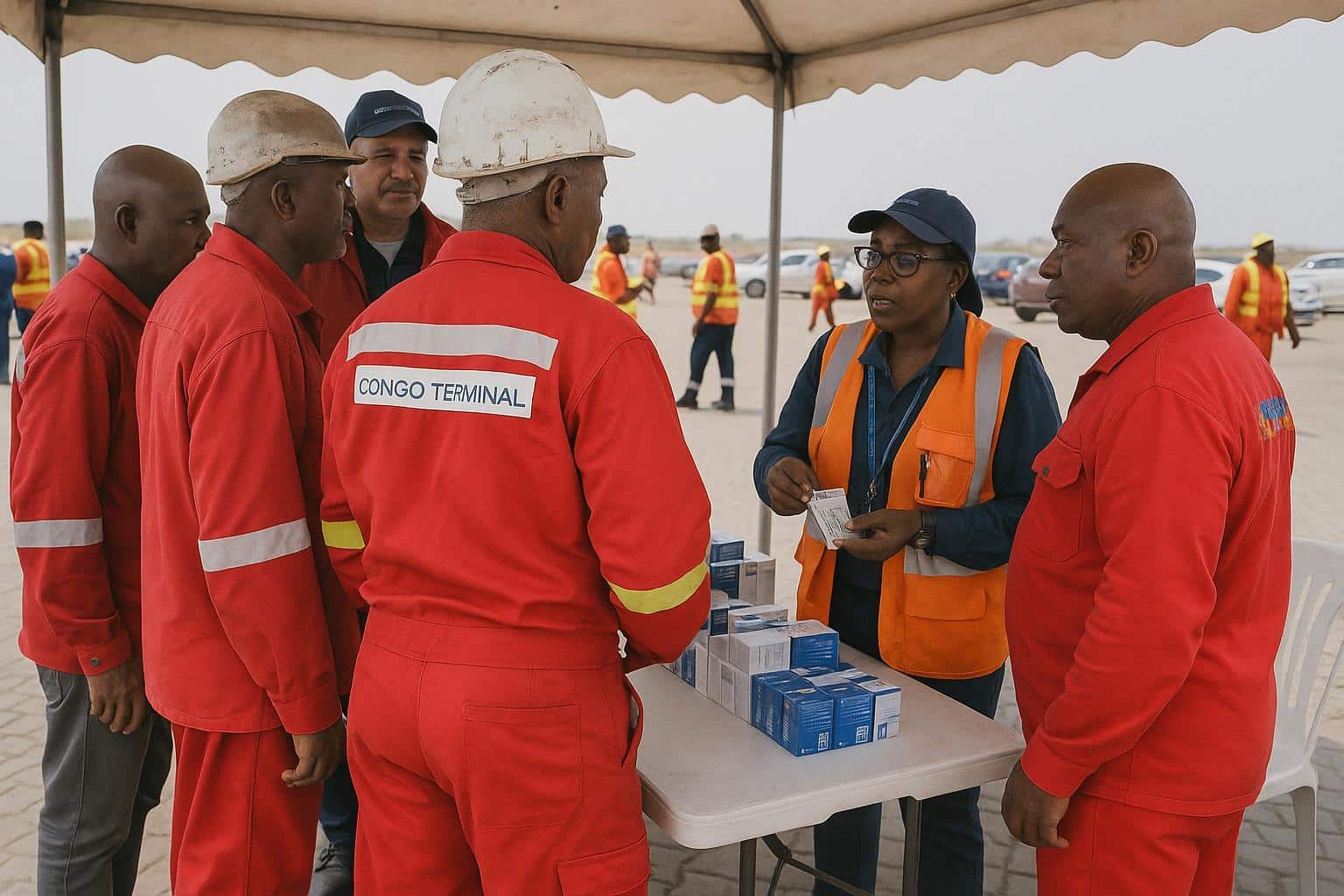
In the busy yards of Pointe-Noire’s container terminal, December’s World AIDS Day triggered a focused mobilisation. Congo Terminal, a subsidiary of Bolloré Ports, gathered more than 900 employees for an on-site awareness campaign designed to curb HIV transmission and reinforce a culture of health.
Regional communications and sustainability head Patricia Ekey-Misse explained that international commemorative days offer a concrete platform for the company to translate policy into action, engaging both staff and adjacent communities while signalling to partners that occupational health remains central to its licence to operate (company statement).
The initiative combined refresher workshops led by company medical adviser Dr Eléazar Céleste Massamba with a distribution of 12,000 condoms, reinforcing the ABC rule—abstinence, fidelity, condom use—that still underpins preventive messaging recommended by the World Health Organization (WHO factsheet).
HIV risk landscape in Republic of Congo
According to UNAIDS, adult HIV prevalence in the Republic of Congo stands near 2.7 percent, lower than regional averages yet persistent enough to warrant sustained vigilance (UNAIDS, 2023). Workplace programmes are therefore seen as critical bridges between national policy and daily behaviour.
Port cities are specific hot spots. Long-distance drivers, maritime crews and informal traders create transient social networks that elevate exposure risks. Health authorities in Pointe-Noire have repeatedly highlighted the need for private operators to complement public clinics with targeted outreach on terminals and logistics corridors.
By anchoring its campaign on site, Congo Terminal reduces absenteeism linked to off-site clinic visits and avoids productivity dips in the peak export season. The firm estimates that collective screening and counselling sessions, completed in under two hours, cost less than a single shift interruption.
Peer education as frontline strategy
Peer educators sit at the heart of the model. Selected among forklift drivers, tally clerks and security guards, they receive periodic scientific updates, develop simple didactic tools and translate medical terminology into Lingala or Kituba, languages that resonate with the workforce’s diverse origins.
During the December rollout, educators installed mobile stands near container lanes, using colour-coded cards to illustrate risk pathways and treatment cascades. Small group dialogues allowed employees to raise sensitive questions without hierarchical pressure, a format perceived as more persuasive than top-down lectures.
Dr Massamba emphasised that HIV is no longer a death sentence but still demands strict adherence to antiretroviral therapy. Early diagnosis, he said, offers the dual benefit of saving lives and protecting co-workers, a message he will now reinforce through quarterly digital newsletters.
Business case for proactive health programs
The campaign also targeted subcontractors: stevedoring cooperatives and truck fleets operating inside the port perimeter. Management argues that harmonised standards across service providers help avoid compliance gaps that could undercut the broader port community’s resilience to communicable diseases.
From an investor standpoint, the initiative signals disciplined risk management. Multilateral lenders increasingly integrate health indicators in environmental, social and governance due-diligence frameworks. Congo Terminal’s parent group is finalising a sustainability-linked loan in West Africa, and lessons from Pointe-Noire are expected to feed future reporting.
Operational gains are equally tangible. A 2022 internal audit found medical evacuations fell by a third after the company adopted on-site HIV screening, tuberculosis testing and malaria prophylaxis, freeing up nearly 1,000 additional man-hours for quay operations during the subsequent financial year (internal data).
Synergy with national and global targets
Nationally, the Ministry of Health has prioritised decentralised HIV services in its 2023–2027 strategic plan, encouraging public-private alliances that extend reach beyond urban hospitals. Congo Terminal’s programme is one example of how corporate footprints can accelerate that decentralisation without duplicating government expenditure.
UNAIDS country representative Marie-Josée Kouame recently noted that corporate initiatives in the extractive and transport sectors, if scaled, could plug nearly a quarter of the resource gap facing national HIV prevention budgets. She cited condom distribution, mobile labs and voluntary counselling as high-impact, low-cost tools.
Congo Terminal plans to extend the peer-education blueprint to its operations in Cabinda, Angola, pending regulatory clearance. Cross-border knowledge transfer, managers argue, will reinforce the Gulf of Guinea’s attractiveness to shippers who increasingly benchmark port operators on sustainability credentials alongside berth productivity.
Back in Pointe-Noire, the company is investing in a digital dashboard that will anonymise testing data and map behavioural trends by job category. The tool, co-designed with a local start-up, is expected to augment decision-making for future health investments and scientific publications.
As the port’s cranes continue to stack containers bound for Central Africa’s hinterland, the broader message from this year’s campaign endures: a healthy workforce underpins reliable logistics. By blending modern medicine with peer solidarity, Congo Terminal illustrates how private action can advance public health goals.
Government officials attending the campaign flagged the port’s initiative as a model for the emerging special economic zones lining the Atlantic coast, where concentrated labour pools may magnify epidemiological risks if preventive infrastructures are not embedded from the outset.