































Paris meeting links diaspora and economic diplomacy
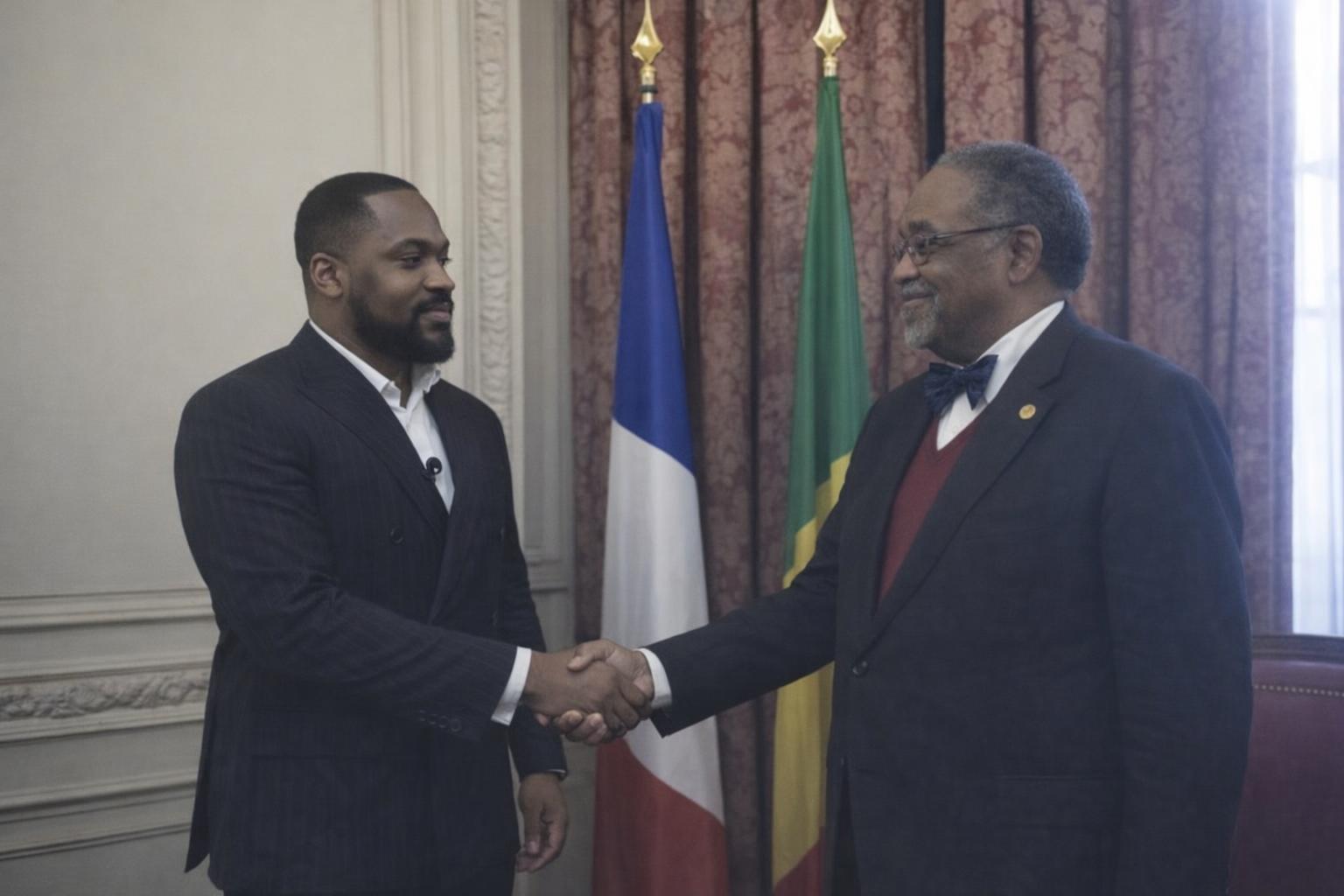
In Paris, Ambassador Rodolphe Adada received Abed Okanguebe, a Congolese national living in France and active in the champagne sector. The exchange was presented as part of a broader effort to strengthen ties between Congolese abroad and their official representation.
For Okanguebe, the visit was framed as an initial step before presenting the project to authorities in the Republic of the Congo in Brazzaville, and later to other audiences internationally. The approach reflects a familiar sequence in diaspora entrepreneurship: credibility-building abroad, then structured visibility at home.
Mea Makoua positions itself as a brand with narrative capital
Okanguebe used the meeting to describe the “soul” of Mea Makoua, presenting the brand as rooted in childhood dreams, oral heritage, and personal ambition. The narrative emphasizes identity and transmission, elements often deployed to differentiate premium products beyond price and technical specifications.
The entrepreneurs portray the house as built “in their image,” a formulation that signals more than commercial intent. In practice, this kind of storytelling can help a young label enter crowded luxury markets, where origin stories, symbolism, and a clear positioning are often as decisive as distribution.
From passion project to champagne production in their own barrels
According to the account shared during the reception, Geordy Obili and his childhood friend chose to pursue champagne production using their own barrels. The text presents the initiative as driven by passion and by the desire to shape a distinctive product rather than merely participate as intermediaries.
As the brand communicates, the wine is meant to be enjoyed with elegance and moderation, with an explicit reminder that alcohol abuse is dangerous for health. This framing keeps the message compatible with public-health norms while maintaining the codes of refined consumption used in premium sparkling wine marketing.
A “bridge” between Congo’s memory and Champagne tradition
Mea Makoua’s public argument is built around dialogue between two worlds: the “silent nobility” of their native lands and the wealth of the Champagne tradition in France. The founders present their ambition as establishing a bridge between terroir and memory, excellence and identity.
In diplomatic and investor-facing language, such positioning can be read as soft power at the micro level. A diaspora brand becomes a vector of cultural projection and a signal of skills circulation, aligning private initiative with broader narratives of national visibility and international partnership.
Direct quote underscores Africa’s role in premium value chains
Speaking for himself and his partner, Abed Okanguebe stated: “We believe Africa must no longer only consume the world’s great wines… It must write the next legends… Mea Makoua is not a simple brand, it is an invitation to write together a new page in the history of champagne carried by our voices, our stories, our souls…” (Abed Okanguebe).
The quote articulates a shift from consumption to authorship, a recurring theme in contemporary African entrepreneurship. While the project is anchored in France’s Champagne region, the founders insist on African narrative agency, seeking to attach Congolese identity to a product category traditionally guarded by strict heritage.
Luxury, identity and the diplomatic value of symbols
Okanguebe further presented the venture through an evocative language of crystal, bubbles, and memory, describing each bottle as a meeting point between past and future. The register is intentionally ceremonial, borrowing from luxury storytelling where emotion is treated as part of the product.
In his description, the concept “revives” the spirit of lost kingdoms and a view of luxury as culture and art of living. Read carefully, the message is less about historical claims than about a symbolic architecture meant to give the brand legitimacy, depth, and differentiation.
Makoua as heritage marker and cross-border brand architecture
In the narrative shared at the embassy, “Makoua” is presented not as a simple name but as an inheritance, forged in a synthesis between Africa and Champagne in France. Each bottle is described as a treasure and a bridge between two “majesties,” reinforcing the idea of dual belonging.
For decision-makers, the subtext is clear: diaspora-led ventures may combine cultural referencing with production in established jurisdictions, thereby using global value chains to create reputational assets that can later support commercial expansion and institutional recognition in the Republic of the Congo.
Excellence claims anchored in the Champagne region’s prestige
Because the concept is said to be designed at the heart of a prestigious Champagne area, the founders argue that each bottle embodies excellence and distinctive know-how. The messaging leans on the region’s reputation to reassure consumers and partners about standards and craftsmanship.
In competitive terms, the stated objective is to deliver a “cru” with a Congolese touch. Without detailing volumes or distribution, the text nonetheless suggests a premium strategy: emphasizing uniqueness, careful presentation, and the credibility effects that come from operating within recognized French production ecosystems.
Embassy reception highlights encouragement and visibility
The account notes that Ambassador Rodolphe Adada appeared receptive to the presentation and tasted three cuvées offered for dégustation. He then wished the project strong success and expressed the hope that the initiative would help the Republic of the Congo shine through the work of its pioneers.
For diaspora entrepreneurs, such encouragement can matter as a signal, even if it does not imply formal endorsement beyond goodwill. In diplomatic practice, hosting and listening are also instruments of economic diplomacy, helping identify initiatives that may later be showcased in Brazzaville or abroad.
What investors and institutions may watch next
The next step mentioned is a presentation to Congolese authorities in Brazzaville, followed by outreach “elsewhere in the world.” If pursued, the trajectory would test the brand’s ability to convert narrative capital into structured market access, partnerships, and sustained demand.
For institutions and business audiences, the case illustrates a broader pattern: the diaspora as a pipeline of entrepreneurial projects that blend identity, premium positioning, and international know-how. In that sense, Mea Makoua is also a small window into how reputations are built across borders.