


























Brazzaville TV series puts the five-year plan in focus
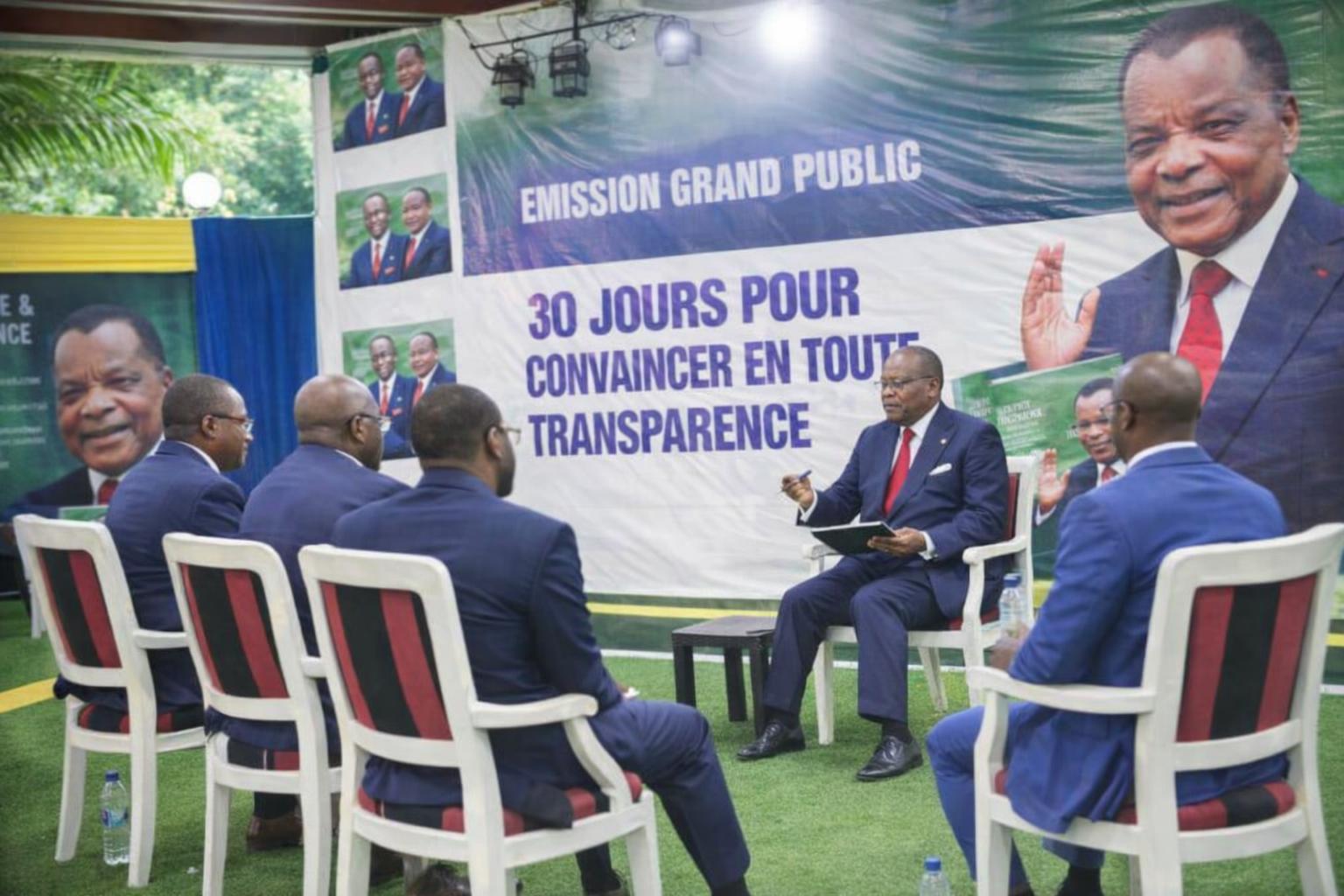
Brazzaville hosted a politically significant public discussion on 8 January, as Prime Minister Anatole Collinet Makosso presented the key directions of Congo-Brazzaville’s 2021-2026 five-year plan. He referred both to actions already recorded and to the operational difficulties encountered by the government (ACI).
The remarks came during the first episode of “30 Days to Convince”, a public-facing broadcast format designed to popularise and explain the book “En toute transparence 2021-2026”. The publication is prefaced by President Denis Sassou-N’Guesso and is framed as an accessible account of the term’s balance sheet (ACI).
“30 Days to Convince”: public diplomacy for citizens and diaspora
Organisers presented the programme as a frank exchange intended to clarify, for Congolese at home and in the diaspora, the content and broader stakes of “En toute transparence 2021-2026”. The initiative positions communication as a policy tool, with the studio serving as a bridge between institutions and public expectations (ACI).
In the framing relayed by the Prime Minister, the President’s approach in the book is to provide information and invite each citizen to form a judgement based on the material made available. The emphasis is on transparency as a method of political accountability and civic engagement (ACI).
Five-year plan narrative: progress, constraints, and context
While detailing the plan’s main axes, the Prime Minister also acknowledged that implementation has combined measurable achievements with constraints. The messaging underlines that public action is assessed not only by declared objectives, but by execution conditions and the capacity to overcome administrative or sectoral bottlenecks (ACI).
In this format, the five-year plan is treated as both a policy document and a communication object. The studio conversation translates institutional language into a narrative that can be debated, understood, and compared with lived realities, including in remote localities and among expatriate communities (ACI).
Government officials scheduled to present sector balance sheets
At the end of the first programme, Digne Elvis Salissan, coordinator of “Dynamique le Patriarche”, said the platform would host, over 30 days, members of government, experts, local elected officials and public administration managers. The objective is to cover the 2021-2026 record in a structured sequence of interviews (ACI).
Salissan described the exercise as a pedagogy of public action: stating what was done, what was not done, why it was not done, and under what conditions results were obtained. He also stressed the national reach of the effort, citing communities in Sangha, Kouilou and Niari as intended audiences (ACI).
A political timetable leading to a presidential synthesis
According to Salissan, the series is also designed to prepare for a later political moment. He indicated that it would set the stage for candidate Denis Sassou-N’Guesso to deliver a synthesis of the book and to present a new project for the next five years. The initiative therefore blends policy review with forward planning (ACI).
This sequencing reflects a common diplomatic and governance logic: consolidate a narrative of action, clarify constraints, then articulate the next agenda. For investors and institutional partners, such staging can be read as an effort to improve readability of public priorities, even as details remain discussed in real time (ACI).
First guests and upcoming sessions: ministers and state firms
The first day’s studio also hosted Pierre Mabiala, Minister of State and Minister of Land Affairs and the Public Domain, as well as Juste Désiré Moundélé, Minister of Urban Sanitation, Local Development and Road Maintenance. Their presence signalled a multi-sectoral approach consistent with government-wide reporting (ACI).
Organisers said that nearly 14 ministers were already scheduled for upcoming broadcasts, alongside several directors general. Those cited included executives from the airline Ecair, the national electricity company Énergie électrique du Congo (E2C), and the national oil company Société nationale des pétroles du Congo (SNPC) (ACI).
Why the format matters for decision-makers and the diaspora
By bringing ministers and public managers to a recurring public platform, the series creates a predictable channel for clarifying policies and performance. For businesses, financiers, and the diaspora, this can help map which sectors are being prioritised and how authorities communicate challenges as well as deliverables (ACI).
Salissan was also noted as coordinator of the Génération auto-entrepreneur (GAE) platform. That detail suggests the organisers’ interest in linking political communication with broader social and economic aspirations, including entrepreneurship narratives that can resonate with young professionals and overseas Congolese networks (ACI).