






















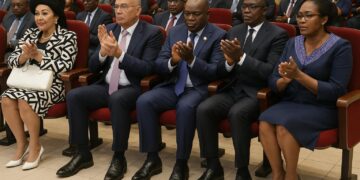


Strategic Appointment Bolsters CDECO Influence
CDECO, the Congolese centre dedicated to economic cooperation, has expanded its international advisory committee by appointing Deve Maboungou as Director of Economic Intelligence and Global Influence. The move underscores Brazzaville’s intention to weave competitive intelligence more tightly into its economic diplomacy and investment promotion architecture.
Announced during a briefing in Pointe-Noire, the nomination aligns with the government’s 2022-2026 National Development Plan, which places knowledge capital and strategic partnerships at the core of diversification efforts (CDECO press release, 21 March 2024). Observers read the decision as a signal of rising professionalisation inside public agencies.
A Track Record Forged in Intelligence Circles
Founder of advisory firm Noeîn & Cie, Maboungou combines fifteen years of field experience in foresight analysis, risk mapping and influence management. He previously steered La Maison de l’Afrique in Paris, a platform praised for connecting African negotiators with European financiers and think-tank communities.
His portfolio includes support for energy, mining and telecom operators seeking market intelligence across Central Africa. Clients describe his method as data-driven yet culturally intuitive, an approach that matches the government’s push to ground policy advocacy in both quantitative dashboards and nuanced understanding of regional political economies.
Mandate Focused on Competitive Intelligence Integration
At CDECO, the new director will map sectoral opportunities, monitor emerging regulations and craft influence campaigns in strategic markets such as the Gulf, China and the European Union. The brief also covers early-warning systems designed to secure supply chains for forestry, hydrocarbons and digital infrastructure projects.
Speaking after his confirmation, Maboungou explained that intelligence is ‘no longer a luxury; it is the radar that keeps growth trajectories on course.’ He promised quarterly dashboards detailing investor perception, policy risks and partnership pipelines, tools that development banks frequently request before approving concessional credit lines.
Potential Upside for Investors and SMEs
Capital markets analysts argue the appointment could accelerate the flow of reliable data to prospective investors, traditionally deterred by information asymmetries in Central Africa. Clearer visibility on regulatory timelines and project pipelines may lower transaction costs for small and medium-sized enterprises eyeing public-private partnerships in logistics or housing.
Several banking executives contacted in Brazzaville pointed to CDECO’s expanding database on sovereign risk metrics as a ‘game-changer’ for pricing longer-tenor bonds. They expect the intelligence unit to liaise closely with the Ministry of Finance and the BEAC regional central bank in aligning macroeconomic assumptions.
Synergies With Diplomatic Networks Abroad
Maboungou’s August 2023 designation as Ow’Isaza, or special envoy, of the Ugandan Kingdom of Bunyoro-Kitara to France adds a layer of soft power to CDECO’s toolkit. Royal court links often open doors in Commonwealth jurisdictions where Congolese businesses seek agribusiness, timber and energy joint ventures.
Diplomats interviewed in Paris note that such multicultural credentials resonate with diaspora investors who value cross-border legitimacy. ‘When you navigate multiple protocols, you translate opportunity across cultures,’ said a senior counsellor at an OECD mission, predicting stronger participation of Franco-Congolese capital in upcoming infrastructure tenders.
Governance and Safeguards
CDECO chair Jean-Louis Ondélé emphasised governance, noting that the intelligence unit will operate under a code of ethics aligned with COBAC banking regulations and the regional data-protection act. ‘Transparency breeds credibility,’ he said, outlining annual external audits and regular briefings to the Prime Minister’s office.
By institutionalising safeguards, the committee seeks to avoid conflating influence activities with political lobbying, a nuance vital for maintaining the Republic of Congo’s constructive relations with multilateral lenders. Legal scholars at Marien-Ngouabi University welcome the framework, calling it a benchmark for state-owned entities operating abroad.
Next Steps and Measurable Targets
The roadmap assigns the first ninety days to a diagnostic phase covering data architecture, stakeholder mapping and key performance indicators. Deliverables include a cross-ministerial dashboard on trade flows and a risk heatmap for strategic sectors, to be presented during the 2024 Congo Investment Forum in Brazzaville.
Longer term, CDECO aims to certify its processes under ISO 56002 for innovation management and to join global intelligence fora such as the Society of Competitive Intelligence Professionals. Officials believe such endorsements could reassure export-credit agencies evaluating guarantees for pipelines, fiber-optic corridors or downstream petrochemical complexes.
Steady Path Toward Enhanced Global Visibility
By combining granular analytics with seasoned diplomatic contact, CDECO’s new intelligence arm aspires to refine the country’s narrative abroad and unlock co-investment vehicles aligned with the president’s Growth, Employment and Poverty Reduction strategy. Investors will closely watch the first dashboards to gauge momentum behind promised reforms.
Regional Context of Intelligence Rivalry
Central African neighbours have recently reinforced their own analytical capacities; Cameroon set up a Strategic Foresight Unit in 2022, while Gabon upgraded its Sovereign Fund’s research desk. By positioning Maboungou at CDECO, Brazzaville signals it intends to stay ahead in the competition for diversified foreign inflows.
Economic historian Thérèse Makosso cautions that intelligence alone will not draw capital if administrative procedures lag. Yet she welcomes the committee’s plan to monitor permit issuance times, arguing that public disclosure of such metrics has improved performance in Rwanda and Côte d’Ivoire. Accountability, she says, multiplies credibility.