



























High-profile graduation signals public-private momentum
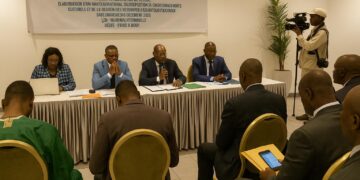
Thirteen newly minted mechanical-engineering technologists crossed the stage of Marien Ngouabi University’s presidential auditorium in Brazzaville on 26 November, cheered on by Defence Minister Charles Richard Mondjo and Higher-Education Minister Delphine Edith Emmanuel during a ceremony that blended military protocol with academic tradition.
The event crowned a three-year professional bachelor programme jointly delivered by the university’s National Polytechnic School and the Defence Ministry’s Technical Training Centre, a collaboration designed to raise Congo-Brazzaville’s pool of mid-level industrial maintenance experts at a time of accelerating infrastructure commitments.
Commentators close to the project described the cohort as a pilot class whose performance will inform wider human-capital strategies embedded in the National Development Plan 2022-2026, which earmarks manufacturing, energy services and logistics as priority growth drivers (government communiqués).
Curriculum mirrors Industry 4.0 requirements
Structured around six semesters of 900 contact hours each, the syllabus mixed hydraulics, pneumatics, electromechanics and digital diagnostics with project management and English for engineering, mirroring competency frameworks promoted by the African Union’s Agenda 2063 for an innovation-led economy.
Practical sessions were hosted inside the ministry’s new Training and Technology facility, where students diagnosed faults on armoured-vehicle subsystems one week and recalibrated port-crane servomotors the next, gaining exposure to defence and civilian equipment that share increasingly convergent supply chains.
Academic performance proved robust: semester-five averages ranged from 13.59 to 15.74 out of twenty, while final project defences attracted grades as high as 18, testimony to what supervising professor Ngouabi Mavoungou called “the discipline that emerges when classroom theory meets the rigour of the barracks.”
Strategic dividends for defence and economy
Officials stress that industrial technicians able to troubleshoot hydraulics in tropical conditions are essential for both national security and sustained uptime at Special Economic Zones such as Maloukou-Tréchot, where time-critical processing of timber and ore depends on reliable heavy machinery.
By embedding the curriculum inside the Defence budget, the state insulates the programme from commodity price cycles that sometimes disrupt civilian training funds, ensuring continuity of supply for the nascent private maintenance ecosystem clustering around Pointe-Noire and Oyo.
Stakeholders also see a soft-power angle: Congolese engineers schooled in disciplined environments can serve in regional peacekeeping logistics, reinforcing the country’s diplomatic standing while opening commercial gateways for maintenance firms certified to North-Atlantic Treaty Organization standards.
Governance, finance and scalability
The 2019 partnership agreement allocates academic oversight to Marien Ngouabi University, while the ministry underwrites equipment, stipends and health insurance, an approach that satisfies the African Development Bank’s blended-finance guidelines even though no external lender is yet involved.
According to Brigadier-General Ambroise Mopendza, head of the ministry’s equipment directorate, capital expenditure per learner averaged CFA 18 million across the three cohorts, a figure he deems “competitive versus sending staff abroad for equivalent aerospace maintenance certificates” (ceremony address).
University officials are now mapping a modular version that could be financed by corporate levies under Congo’s new apprenticeship tax, with pilot seats reserved for women technicians to help lift female enrolment in STEM from today’s estimated nine percent.
Investor and HR implications
Recruiters at the ceremony said the graduates enter a market where TotalEnergies, Zenith Energy and Chinese EPC contractors are expanding maintenance contracts, driving demand for technicians who can interpret digital twins and comply with ISO 55000 asset-management standards.
Human-resources advisers nonetheless caution that remuneration frameworks must evolve; current public-sector scales cap entry-level mechanical technologists at around CFA 550,000 per month, while oil-field subcontractors often offer twice that, risking brain drain if alignment is not addressed in the 2025 budget session.
For private investors, the programme offers a de-risking signal; by anchoring technical competences locally, operating costs linked to expatriate specialists decline, shortening payback periods for capital-heavy projects in agribusiness, cement and renewable-energy installations.
As Congo-Brazzaville intensifies its push toward diversified and sustainable growth, the Defence-university talent pipeline demonstrates how cross-ministerial partnerships can convert budget outlays into immediately deployable skills, generating value for national resilience and for businesses seeking reliable, safety-conscious maintenance teams.
Plans are underway to integrate augmented-reality maintenance overlays into the next cohort’s curriculum, leveraging business partnerships with MTN Congo’s 5G testbed so that technicians can access digital manuals hands-free while working in confined engine rooms or on remote forestry equipment.
If successfully adopted, the innovation could place Congo among early African adopters of predictive maintenance in heavy industry, complementing the country’s climate commitments by reducing unplanned generator emissions and extending the life cycle of critical components.