





















Strategic fleet boosts Pointe-Noire roads
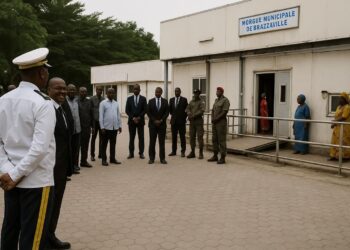
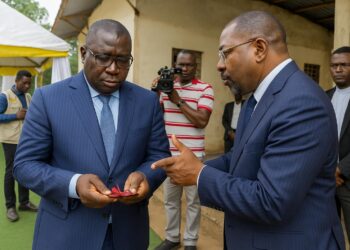
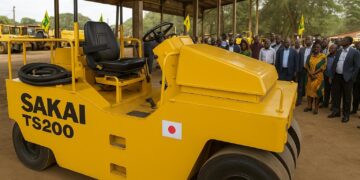
The Ministry of Urban Sanitation, Local Development and Road Maintenance has dispatched a new fleet of asphalt mixers, compactors and service trucks to Pointe-Noire, handing the keys to Prefect Pierre Cébert Iboko-Onanga during a brief ceremony on 17 December.
Minister Juste Désiré Mondélé, speaking for Prime Minister Anatole Collinet Makosso, called the equipment a strategic tool to sustain the city’s modernisation drive and accelerate the rehabilitation of streets, regional roads and auxiliary lanes.
Urban comfort and safety priorities
Mondélé reminded municipal technicians that sanitation extends beyond waste collection to the comfort and safety offered by well-surfaced roads, drained shoulders and orderly traffic.
He therefore authorised partial closures of selected arteries during off-peak hours so crews can operate uninterrupted and deliver higher technical standards.
Port city logistics and regional corridors
Pointe-Noire hosts the deep-water port that anchors Congo’s multimodal corridor strategy, acting as a western gateway for shipments bound for Gabon, Cameroon and Angola.
Well-maintained access roads will cut truck turnaround times, lower freight insurance premiums and support the forthcoming special economic zones mapped along National Highway 1, officials argue.
Discipline safeguards new road assets
The minister issued a clear warning: the machines are government property and may not be rented, sub-leased or immobilised for protocol displays.
Each unit carries a QR-coded plate linked to a realtime telematics platform, allowing the National Road Maintenance Agency to monitor mileage, fuel consumption and deployment schedules.
Infractions will trigger administrative sanctions ranging from written warnings to budgetary withholding, according to the oversight decree circulated after the ceremony.
Japan–Congo partnership accelerates capacity
The acquisition stems from the 2022 technical cooperation agreement signed in Brazzaville between Minister Denis Christel Sassou Nguesso and Japan’s ambassador, under the framework of the Tokyo International Conference on African Development.
According to the Japanese International Cooperation Agency, similar packages in Nairobi and Accra have extended pavement lifespans by three years on average, results Congo now hopes to replicate (JICA, project briefs 2023).
Training sessions for 45 mechanics and operators will begin in January, combining classroom modules at the Port Authority school with on-site diagnostics provided by Japanese engineers.
Financing model opens private opportunities
The equipment is valued at CFA 4.1 billion, financed through a concessional loan carrying a 0.1 percent interest rate and a ten-year grace period, figures confirmed by the Ministry of Finance.
Officials forecast savings of CFA 900 million a year on outsourced resurfacing contracts, freeing fiscal space for street-lighting upgrades and drainage canals.
Local suppliers of bitumen, aggregates and lubricants expect a demand surge once the municipal scheduling board publishes the 2024 works calendar.
Environmental and social dividends
Smoother pavements reduce fuel use by up to six percent on urban routes, translating into lower carbon emissions and cheaper transport for commuters, according to simulations by the Polytechnic Faculty in Brazzaville.
Citizen groups have welcomed the initiative, but ask the council to publish weekly progress dashboards to sustain public confidence and deter vandalism.
Inclusive governance and monitoring
The oversight structure will be chaired by the Prefect and include representatives from the Chamber of Commerce, the civil-society network OCDH and the diocesan Caritas office, ensuring a mix of technical, business and community perspectives.
Monthly scorecards will track kilometres resurfaced, potholes filled, drainage cleared and emissions saved, feeding into the national Open Budget portal launched in October with World Bank support.
PPP and blended-finance prospects
The administration believes transparent metrics will attract blended-finance investors keen on green infrastructure, particularly as Congo readies its second sovereign sustainability bond.
Discussions are advancing with two European asset managers to pilot a performance-based maintenance contract, where payments hinge on lane-roughness indices verified by satellite imagery, an arrangement already tested in Côte d’Ivoire.
Regional competition and market dynamics
Across Central Africa, road density averages 0.08 kilometres per square kilometre, less than one-third of the global mean; Pointe-Noire’s effort thus positions Congo as an early mover in corridor resilience.
Neighbouring Gabon recently issued a $200 million bond for similar upgrades, suggesting a forthcoming race for construction inputs that local entrepreneurs may exploit through regional value chains.
Jobs and skills for youth
The municipality estimates that each kilometre resurfaced creates 18 direct and 27 indirect jobs, ranging from machine operators to catering services, figures that resonate with youth employment targets under the 2022–2026 National Development Plan.
Smart technology pilots predictive maintenance
Engineers will test a cloud-based asset-management system that employs artificial intelligence to predict pavement failure using moisture, axle-load and temperature data collected by embedded sensors, a first for municipal roads in the country.
The pilot is co-financed by a German climate-tech start-up and will run for nine months, after which results will be presented at the Central African Infrastructure Forum scheduled in Brazzaville next November.
Roadmap toward ‘Pointe-Noire-la-Belle’
With machinery on site, the city aims to reseal 28 kilometres of critical arteries before the next rainy season, a milestone Mondélé says will bring the long-standing vision of ‘Pointe-Noire-la-Belle’ within reach.
The ministry plans a mid-term evaluation in 2026 to inform the scale-up to Brazzaville and secondary towns such as Dolisie.