









Presidential spotlight on education
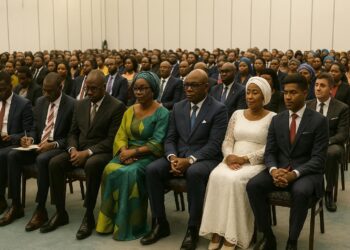
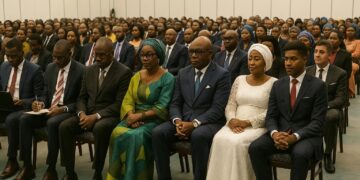
Ngoyo Mantsiendé, a forest clearing eight kilometres north of Dolisie, briefly turned into a national stage as President Denis Sassou-Nguesso cut the ribbon of the General Simon-Pierre Kikhounga-Ngot High School on 19 November 2025, cheered by villagers, students and dignitaries.
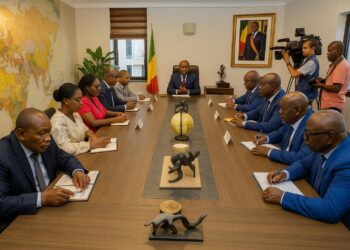
The ceremony, attended by Prime Minister Anatole Collinet Makosso, senior ministers and SNPC chief executive Maixent Raoul Ominga, brought the total number of general high schools in the Republic of Congo to ninety-two, signalling a continued political focus on classroom capacity.
SNPC corporate stewardship advances agenda
Local prefect Micheline Nguessémi framed the project as a milestone within the presidential agenda branded “Ensemble, poursuivons la marche”, a platform that couples infrastructure upgrades with social programmes to improve living standards across the country’s twelve departments.
For SNPC, the national oil company, the site encapsulates its corporate-social-responsibility track record. Ominga called the complex “the expression of the company’s societal commitment” and linked the gesture to the president’s conviction that education remains the cornerstone of inclusive development.
Honouring a national figure
The school bears the name of Simon-Pierre Kikhounga-Ngot, described by officials as one of the architects of Congolese independence. By honouring a national figure, authorities aimed to embed historical consciousness within the daily routines of pupils who will walk its corridors.
Infrastructure tailored for modern pedagogy
Set on six hectares, the campus is organised into three functional zones that mirror modern boarding standards and could, officials claim, accommodate five hundred learners per intake without overcrowding.
The academic block features two double-storey clusters totalling numerous classrooms, dedicated laboratories for sciences and languages, a library and an IT suite, aiming to give rural pupils access to pedagogical tools usually confined to urban hubs.
Residential life is built around two dormitories with three hundred beds each, a refectory of matching capacity, an economat and staff housing, a configuration intended to minimise commuting risks and allow longer study hours.
Sports infrastructure is equally ambitious: a grass football pitch circled by an athletics track, multi-purpose courts for handball and basketball, and two tennis courts. Five vehicles, including two buses, round out the logistics package supporting excursions and inter-school competitions.
Calls for shared responsibility
During the address, Ominga urged students to forge success through perseverance, teachers to cultivate excellence and equity, and parents to reinforce supervision at home, converting the event into a tri-partite call for shared responsibility.
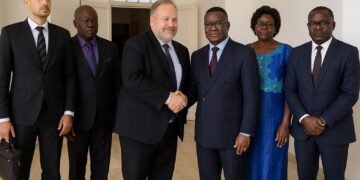
The symbolic key travelled from SNPC to Hydrocarbons Minister Bruno Jean-Richard Itoua, then to Education Minister Jean-Luc Mouthou, underscoring inter-ministerial coordination. Mouthou hailed the head of state as first educator of the nation and underscored Dolisie’s benefit of now hosting two modern lycées.
Rituals and follow-up projects
Traditional elders performed a blessing, after which the president planted symbolic trees, a gesture often associated with growth and stability in local cosmology. The programme concluded with an extensive tour of facilities that allowed the delegation to inspect workmanship and equipment.
Observers note that the visit continued the following day in Sibiti, Lékoumou Department, where Sassou-Nguesso opened a new general hospital, hinting at a sequencing of education and health projects designed to reinforce human capital.
Investor and workforce implications
For investors monitoring social infrastructure, the 500-seat capacity, multi-use sports zone and boarding facilities illustrate a potential model for public-private partnerships whereby state priorities are met through corporate channels without burdening the treasury.
Educational analysts will watch enrolment patterns, gender parity and exam pass rates over the coming academic cycles to gauge whether the enlarged physical footprint translates into learning outcomes, an objective repeatedly emphasised by the Ministry of Primary and Secondary Education.
Niari Department hosts timber concessions, emerging agribusiness and the strategic junction of the Pointe-Noire–Brazzaville corridor. Authorities believe a skilled local workforce will help firms comply with new value-addition rules and environmental standards, reducing dependence on labour imported from coastal cities.
Financing, local value and staffing
Funding terms were not disclosed, yet officials affirmed that the project was fully financed by the SNPC Foundation rather than the company’s exploration budget, an approach meant to ring-fence core petroleum revenues while showcasing voluntary redistribution.
Civil engineers supervising the build cited local procurement of bricks and timber as a cost-containment measure that also injected liquidity into small suppliers, a detail welcomed by prefectural authorities seeking to revitalise post-pandemic rural economies.
As lessons commence, education planners are expected to distribute teachers drawn from recent cohorts of the École Normale Supérieure, aligning subject expertise with the laboratory infrastructure and reinforcing the science orientation promoted by President Sassou-Nguesso in past speeches.
Data-driven monitoring ahead
A forthcoming digital dashboard will track attendance, equipment status and energy use, giving planners evidence to scale similar public-private campuses.